
MJHS
Navigation
Journal Navigation
Article Navigation
opened article
Volum 12, Issue 4
December 2025
Cover Image

Article contents

opened journal
Volum 12, Issue 4
December 2025
Cover Image

Abstract

Introduction

Refractive lens exchange is increasingly utilized for visual rehabilitation in patients with high myopia unsuitable for corneal refractive procedures. While effective, refractive lens exchange with intraocular lens implantation significantly improves visual acuity in young patients with high myopia and astigmatism, while maintaining a low risk of postoperative retinal complications, provided that thorough preoperative vitreoretinal assessment is conducted. However, it carries potential risks, notably retinal complications.

Case presentation

We present a case involving a 45-year-old female with high axial myopia and myopic astigmatism who underwent bilateral refractive lens exchange with the implantation of monofocal intraocular lenses. Comprehensive preoperative assessments included optical biometry, tonometry, fundus examination, and visual acuity measurements. Postoperative recovery was uneventful in the right eye. However, the patient developed a retinal detachment in the left eye approximately one year post-surgery. This complication was successfully managed with pars plana vitrectomy, endolaser photocoagulation, and silicone oil tamponade, resulting in an improvement of visual acuity to 0.3.

Conclusions

Refractive lens exchange can be an effective intervention for patients with high axial myopia but carries a risk of retinal detachment. Thorough preoperative evaluation, meticulous surgical technique, and patient counseling are essential. Prompt detection and management of complications like retinal detachment are crucial for preserving visual outcomes.

Key Messages

What is not yet known on the issue addressed in the submitted manuscript          

Although refractive lens exchange is increasingly used in young patients with high myopia and astigmatism, the long-term safety and optimal patient selection criteria remain unclear, particularly regarding the risk of retinal detachment.

The research hypothesis

Refractive lens exchange with intraocular lens implantation significantly improves visual acuity in young patients with high myopia and astigmatism, while maintaining a low risk of postoperative retinal complications, provided that thorough preoperative vitreoretinal assessment is conducted.

The novelty added by manuscript to the already published scientific literature

This clinical case demonstrates that even in young myopic patients, refractive lens exchange can achieve excellent outcomes when retinal health is thoroughly evaluated preoperatively. It also underlines the importance of early detection and prompt management of retinal detachment, which, although rare, remains a significant risk.

Introduction

Refractive Lens Exchange (RLE) is becoming an increasingly popular procedure, especially for individuals who are not suitable candidates for keratorefractive surgeries. It is particularly considered for patients with high degrees of myopia or hyperopia. However, the widespread availability of phacoemulsification devices and the growing number of surgeons trained in this technique have led to a reduction in the minimum age at which RLE is performed [1].

Case presentation

A 45-year-old female patient, B., presented to the Eye Microsurgery Ophthalmologic center in Moldova, with complaints of decreased visual acuity in the left eye (OS) for the past 9–10 days. Ophthalmologic history revealed that the patient had undergone clear lens phacoemulsification with monofocal IOL (Alcon Acrysof IQ) implantation in both eyes one year earlier. The ophthalmological examination findings are presented below in Table 1.

Table 1. Physical examination and instrumental data


OD

OS

UDVA

0.35

0.01

BDVA

0.75

0.01

Autorefraction

-2.00 D sph / -0.75 D cyl ax 5

-1.50 D sph / -1.25 D cyl ax 43°


Tonometry

17 mmHg

18 mmHg

Biometry

29.97 mm

28.3 mm

Biomicroscopy

Normal conjunctiva, white pearly sclera, clear smooth cornea, medium-depth anterior chamber, round reactive pupils, normal iris stroma, centered IOLs.

Normal conjunctiva, white pearly sclera, clear smooth cornea, medium-depth anterior chamber, round reactive pupils, normal iris stroma, centered IOLs.

Fundus Examination

Flat, well-defined optic disc, mild peripapillary atrophy, C/D = 0.4, diminished macular reflex, moderately narrowed arteries and dilated veins, mobile vitreous opacities.

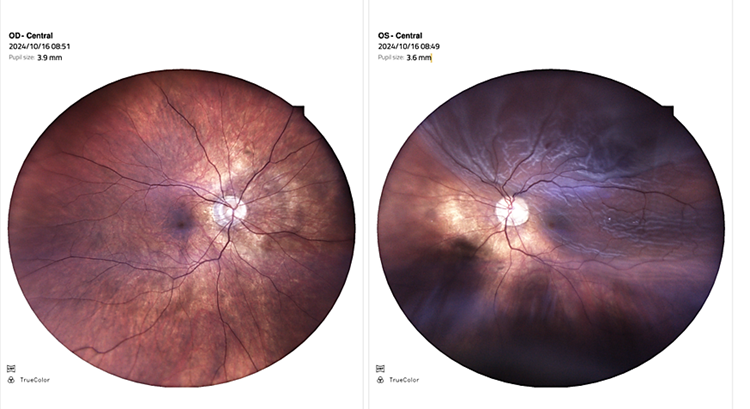
Superior sectorial retinal detachment, macula off (Figure 1)

Note: OD - Right eye; OS - Left eye; UDVA - Uncorrected distance visual acuity; BDVA - Best corrected distance visual acuity; IOL - Intraocular lens; C/D - Cup/disc ratio.

Fig. 1 Fundus photo at initial visit

OD – Retina is attached, peripapillary atrophy, macular reflex is attenuated.
OS – Superior retinal detachment (white cross), macula off (yellow rhombus)

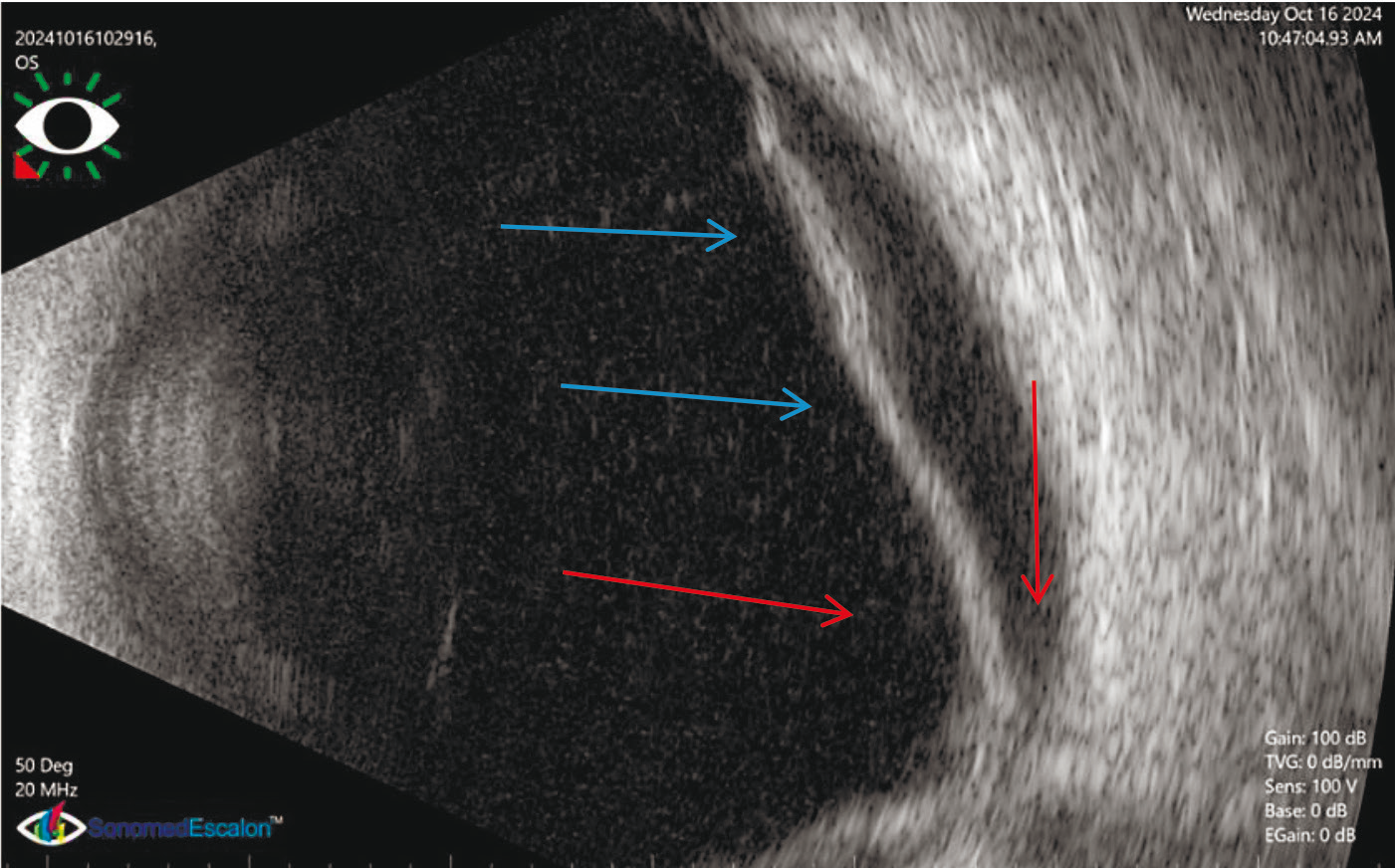
An ultrasound examination of the left eye was performed shown on Figures 2 & 3.
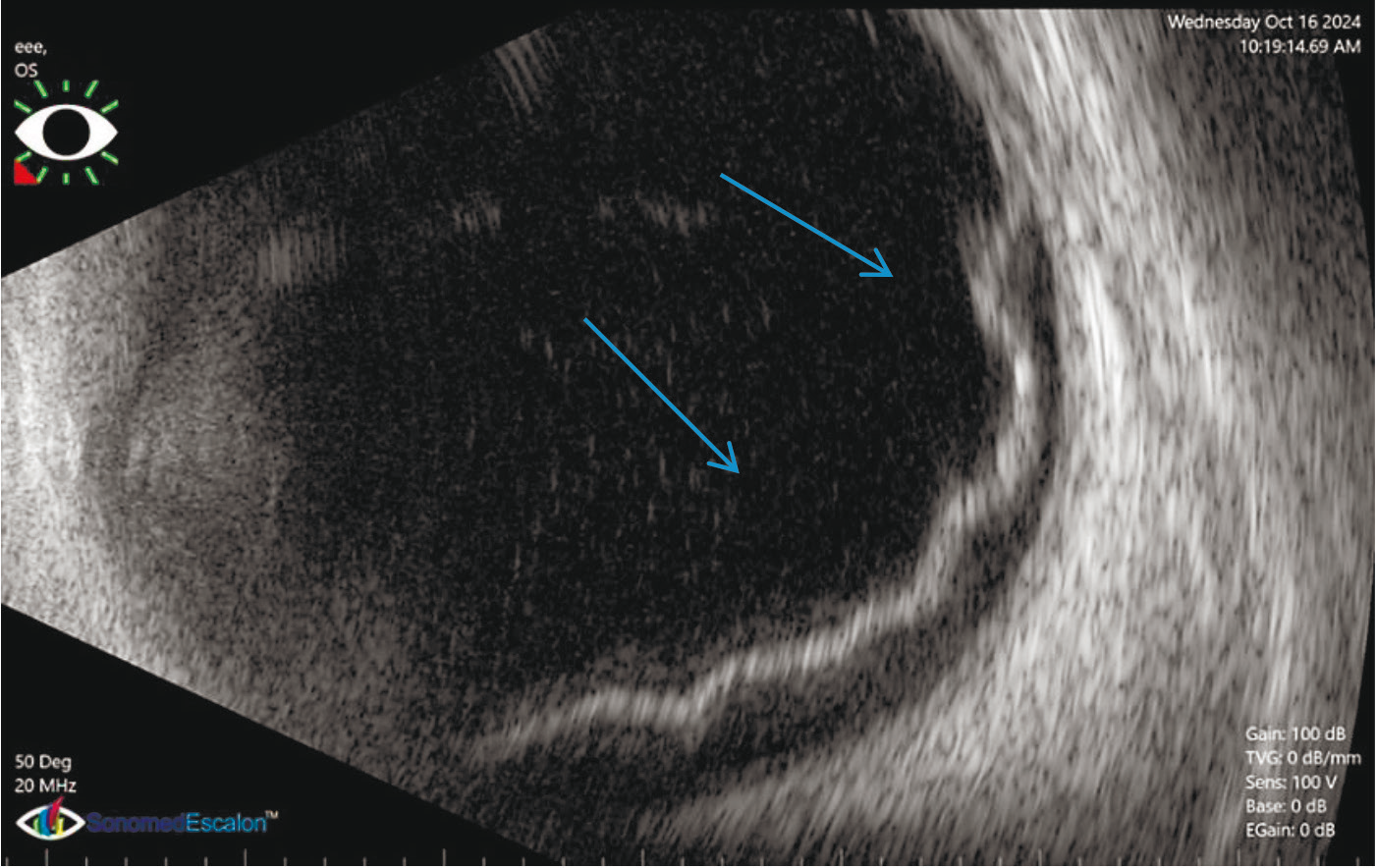
Fig. 2 OS B-scan 

OS Retinal detachment (blue arrows).

Fig. 3 OS B-scan 

OS Retinal detachment (blue arrows), optic disc (red arrows).

The patient was diagnosed with OS: Rhegmatogenous retinal detachment, macula off; OU: Pseudophakia (postoperative high myopia), status post RLE and vitreous body degeneration.

Vitrectomy with endolaser photocoagulation and silicone oil tamponade was performed in the left eye (OS).

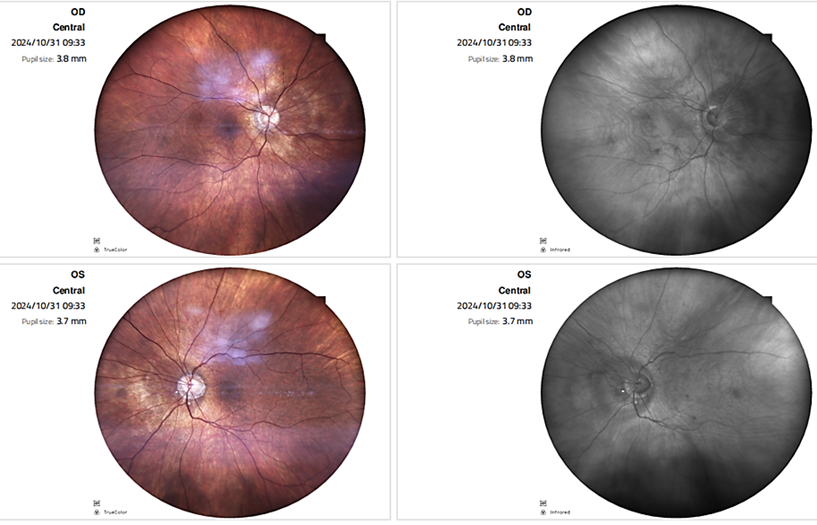
Postoperative follow-up (after 2 weeks) revealed OS BDVA of 0.3 and fundus examination (OS) with showed the retina reattached (Figure 4).

Fig. 4 Fundus photo OS Retina attached under silicone oil

Discussion

One of the main considerations when evaluating refractive lens exchange (RLE) is the timing of posterior vitreous detachment (PVD). Patients with high myopia tend to develop PVD at a younger age compared to those without significant myopia.

Retinal detachment (RD) after RLE in highly myopic patients has been reported with an overall prevalence between 1.5% and 8.1%, depending on follow-up duration in various studies [1]. For comparison, the annual incidence of RD in the general population with high myopia is around 0.102%.

RD after RLE may be linked both to a predisposing factor (a higher prevalence of peripheral retinal lesions in highly myopic eyes) and a triggering factor (vitreous changes induced by the surgical procedure). Younger patients, especially those with an axial length greater than 26 mm (typically associated with myopia > -6.00 D), are at increased risk. The group with the highest risk includes patients under the age of 50 with an axial length exceeding 28 mm [1].

According to several sources, myopic eyes have a threefold higher risk of RD compared to the general cataract population [2].

Retinal complications – particularly in highly myopic eyes after refractive surgeries like RLE are primarily attributed to two main causes:

  • a higher incidence of predisposing peripheral retinal lesions in myopic eyes, and

  • the hypothesis that refractive surgery may induce certain iatrogenic factors increasing the incidence of such pathology [1, 3].

To prevent retinal detachment, careful preoperative fundus examination with scleral depression is necessary to assess the vitreous body. During surgery, minimal disturbance of the intraocular environment is essential. Some authors recommend bimanual microincision phacoemulsification (BMMI) or small-incision lens extraction in myopic eyes [1, 4].

During lens implantation, a transient drop in intraocular pressure (decompression effect) can lead to changes in the vitreous, particularly in eyes with existing vitreous degeneration. Protein alterations identified in pseudophakic eyes often coincide with structural changes in the vitreous body, which may contribute to the development of retinal complications postoperatively.

Preoperative determination of retinal detachment risk – especially in myopic eyes with axial length over 26.0 mm and spherical equivalent greater than -6.00 D – is of high importance [1, 5]. In young myopic patients, clear lens extraction may trigger vitreous changes and retinal traction not commonly seen in older patients undergoing age-related cataract surgery [1].

Conclusions

RLE is an intraocular surgical procedure that must be performed with precision and high accuracy. The indication for this intervention is the presence of a significant refractive error in the absence of cataract, and it requires a risk-benefit approach, taking into account the patient's age, refractive condition, and preoperative status. It is important to inform patients about the possible complications.

Competing interests 

None declared.

Authors’ contributions 

SP conducted the preoperative and postoperative assessment of the patient and collected the clinical data and performed the literature review. IT structured the article, drafted the conclusions. AP reviewed and revised the manuscript and recommended relevant literature to support the conclusions. All authors reviewed the manuscript critically and approved the final version.

Informed consent for publication

Obtained.

Acknowledgements and funding

We thank the Eye Microsurgery Ophthalmologic Center in Moldova, Chișinău, Republic of Moldova, for granting permission to conduct the clinical work. The study had no external funding.

Provenance and peer review

Not commissioned, externally peer review.

Authors’ ORCID IDs

Serghei Porada – https://orcid.org/0009-0000-7476-3527

Iulia Tanurcova – https://orcid.org/0009-0000-2242-1699

Ala Paduca – https://orcid.org/0000-0002-9879-8211

References

  1. Alio JL, Pederzolli M, Grzybowski A. Refractive lens exchange: What are the red lines? Eur J Ophthalmol. 2024 Mar;34(2):317-322. doi: 10.1177/11206721231218909.

  2. Rosen ES. Risk management in refractive lens exchange. J Cataract Refract Surg. 2008 Oct;34(10):1613-4. doi: 10.1016/j.jcrs.2008.08.001.

  3. Ruiz-Moreno JM, Alio JL, Shabayek MH. Complications of refractive lens exchange. In: Alio JL, Azar DT, editors. Management of complications in refractive surgery. Berlin: Springer; 2008. p. 266-269.

  4. O'Brien TP, Awwad ST. Phakic intraocular lenses and refractory lensectomy for myopia. Curr Opin Ophthalmol. 2002;13(4):264-270. doi: 10.1097/00055735-200208000-00015. 

  5. Alio JL. Lens surgery (cataract and refractive lens exchange) and retinal detachment risk in myopes: still an issue? Br J Ophthalmol. 2011;95(3):301-303. doi: 10.1136/bjo.2010.186429.

More articles

Research Expression of estrogen and progesterone receptors and their clinicopathological correlations in serous ovarian carcinoma
Valeria Pînzaru1,2*, Tatiana Mărițoi1,3, Valeriu David1,4, Ecaterina Foca4, Lilian Șaptefrați1,4
https://doi.org/10.52645/MJHS.2025.4.01
Ovarian cancer continues to be the most lethal gynecologic malignancy, with high-grade serous ovarian carcinoma representing the most common and aggressive histological subtype. Although estrogen receptor and progesterone receptor have established prognostic and therapeutic relevance in other hormone-dependent cancers, such as breast carcinoma, their role in high-grade serous ovarian carcinoma remains insufficiently characterized and requires further elucidation.
Research Chromosomal variations in infertile men diagnosed by cytogenetic analysis
Stela Racoviță1,2 Veaceslav Moșin3, Svetlana Capcelea1, Ana Mișina4, Vasile Racoviță5, Elena Chesov1,2, Mariana Sprincean1,6
https://doi.org/10.52645/MJHS.2025.4.02
Male infertility has a heterogeneous etiology, most commonly caused by disorders of spermatogenesis, clinically manifested as azoospermia or severe oligospermia. Genetic factors account for approximately 30% of male infertility cases associated with azoospermia. This high frequency is due to the involvement of numerous genes in the regulation of sexual development and reproduction. Among the various genetic causes of spermatogenic failure, chromosomal abnormalities are among the most clinically significant. The objective of the study was to evaluate the profile of chromosomal variations in infertile men with azoospermia, to optimize assisted reproductive strategies in infertile couples.
Research Electrocardiographic changes in patients with acute pulmonary embolism
Doina Ranga*, Cornelia Talmaci, Sergiu Matcovschi, Natalia Caproș
https://doi.org/10.52645/MJHS.2025.4.03
Pulmonary embolism is a life-threatening condition requiring prompt diagnosis. While contrast-enhanced computed tomography is the gold standard, its limited availability and associated risks necessitate complementary diagnostic tools. Recent studies suggest that combining multiple electrocardiographic abnormalities into a composite score may enhance diagnostic performance.
Research Descriptive analysis of pediatric laryngeal papillomatosis in Republic of Moldova: epidemiological and clinical characteristics
Daniela Cernev*, Vasile Cabac
https://doi.org/10.52645/MJHS.2025.4.05
Recurrent laryngeal papillomatosis is a rare but significant pediatric condition caused by human papillomavirus types 6 and 11. Characterized by the repeated growth of benign exophytic lesions in the respiratory tract, recurrent laryngeal papillomatosis poses a considerable burden due to its recurrent nature, frequent need for surgical intervention, and potential impact on respiratory function. This study aims to describe the epidemiological profile of pediatric recurrent laryngeal papillomatosis in the Republic of Moldova, identify high-risk groups, and explore the socioeconomic implications of the disease.
Research Prevalence and severity of depression, anxiety, and cognitive impairment in acute ischemic stroke patients: a cross-sectional study
Mihaela Belous1*, Radislav Cosulean1, Dorin Jelaga1,2, Igor Nastas1,2, Jana Chihai1,2, Madalina Bivol1, Larisa Boronin1,2, Andrei Esanu2, Alina Bologan2, Cornelia Adeola2
https://doi.org/10.52645/MJHS.2025.4.06
Post-stroke depression (PSD) and anxiety are common neuropsychiatric sequelae of stroke, occurring in roughly one-third of survivors. Cognitive impairment is also frequently observed, affecting up to half of stroke patients. These conditions adversely impact rehabilitation and quality of life. This study aimed to determine the prevalence and severity of depression, anxiety, and cognitive deficits in patients with acute ischemic stroke.
Research The relationship between zinc levels and immunological biomarkers in oral fluid in children affected by dental caries
Svetlana Plamadeală1*, Olga Tagadiuc2, Aurelia Spinei1
https://doi.org/10.52645/MJHS.2025.4.07
Dental caries is one of the most widespread diseases in the human population, and the causes of increased susceptibility to dental caries remain of continuing interest to researchers. Active immunological components of oral fluid significantly influence the evolution of dental caries. The aim of this research is to study the relationship between zinc levels, the antimicrobial peptide LL-37, and transforming growth factor beta-1 in oral fluid, and the incidence of dental caries in children.
Research A simple method for preparing herbal reference standards based on salting-out solvent extraction
Igor Casian*, Ana Casian
https://doi.org/10.52645/MJHS.2025.4.08
The expansion of the range of herbal medicinal products requires the availability of a large number of different reference standards for their analysis. A possible solution is the use of herbal reference standards (HRS), which, in turn, requires the development of simple production methods that meet all the requirements for reference standards
Research Toxico-hygienic and economic aspects of acute non-occupational chemical poisonings in the Republic of Moldova during the period 2019-2023
Tatiana Tonu1*, Iurie Pînzaru2, Ludmila Goma3, Natalia Daniliuc4
https://doi.org/10.52645/MJHS.2025.4.09
Acute non-occupational chemical poisoning is a current public health problem in the Republic of Moldova, affecting both children and adults. The global increase in the use of chemical substances and mixtures raises the risk of chemical poisoning, which ranks fourth among the causes of injury in children, after road traffic injuries, burns, and drowning. It also generates a significant economic burden, and its quantification contributes to making informed decisions regarding the efficient allocation of resources.
Research Contemporary approach to pediatric ovarian tumors
Corina Iliadi-Tulbure*, Catalin Caus, Bogdan Marandiuc, Olga Cernetchi
https://doi.org/10.52645/MJHS.2025.4.12
Pediatric ovarian tumors represent a rare but clinically important category of gynecologic conditions, comprising approximately 1-2% of all childhood malignancies and about 5% of pediatric abdominal masses. While most are benign, a meaningful percentage can be hormonally active, raising diagnostic and therapeutic challenges. Due to nonspecific symptoms such as abdominal pain or distension, early diagnosis is often delayed, potentially compromising fertility preservation and long-term outcomes. A multidisciplinary, age-specific approach is essential to optimize management.
Review Current concepts in the management of bone lesions in multiple myeloma
Bone lesions remain a serious, unresolved issue in patients with multiple myeloma. The management of myeloma-related bone disease involves a multimodal approach, including chemotherapy, bone antiresorptive agents (bisphosphonates), radiotherapy, pharmacological pain management, minimally invasive percutaneous orthopedic procedures, and invasive surgical interventions.
Review Stigmatization in medicine: impact on patients, healthcare providers, and ethical standards of care
nga Anisei-Cojocaru*, Liliana Rogozea
https://doi.org/10.52645/MJHS.2025.4.11
Stigmatization is a social phenomenon that adversely affects not only access to care but also the quality of medical services. In the medical context, stigma occurs when patients – or even healthcare professionals – are treated differently, with prejudice or a lack of empathy, due to certain traits, conditions, or social affiliations.
Review β-adrenergic agonists and β-antagonists in sport performance: a narrative synthesis of pharmacological effects and anti-doping implications
Tatiana Chiriac1*, Ina Pogonea1, Tatiana Timercan2, Artiom Jucov 3,4, Silvia Stratulat2, Alisa Tăbîrță5, Victoria Chihai5
https://doi.org/10.52645/MJHS.2025.4.13
In the context of increasingly intense athletic competition, athletes are motivated to enhance their performance through various methods, including the use of pharmacological substances that act on the adrenergic system. Among these, β2-adrenergic agonists are employed for their metabolic effects and their role in increasing endurance, whereas β-adrenergic antagonists are used in precision sports to reduce tremor and control anxiety. Both classes of substances present potential benefits as well as health risks, and are subject to strict regulations in high-performance sports.
Review Digital planning in orthodontics. Applicability of the Kau, Pan, Gallerano index in contemporary orthodontics
Valentina Trifan*, Ana Bolgari, Iana Baiceva, Daniela Trifan, Irina Zumbreanu
https://doi.org/10.52645/MJHS.2025.4.14
Digital planning in modern orthodontics is crucial in contemporary era, as it allows dentists to expand the limits of patients’ diagnosis and clinical treatment. Using tools such as 3D scanners, cone beam computed tomography with various software gives clinicians the opportunity to achieve more precise diagnoses and accurate predictions of treatments. In this way, digital imaging offers a precise localization of impacted canines which allows for the integration and applications of the Kau, Pan, Gallerano index