
Introduction
Recently, at the global level, there has been an increase in the use of chemical substances and mixtures in various areas of human activity, such as industry, agriculture, and households [1].
This contributes to an increased risk of accidental or intentional exposure to chemical agents, with a direct impact on public health. According to data from the specialized literature, approximately 3,000 chemical substances are involved in the production of acute chemical poisonings, out of a total of over 100 million known natural or synthetic compounds (over 350,000 artificially synthesized) at the global level [2-5].
Acute non-occupational chemical poisonings represent a current public health problem, with a major impact on morbidity and mortality worldwide [6-7]. They constitute one of the main causes of patient presentation to emergency departments and admission to intensive care units, affecting particularly vulnerable populations, such as children and adolescents [8-10].
According to the World Report on the Prevention of Injury in Children, poisonings of chemical origin rank fourth in incidence in 16 countries, after road traffic injuries, burns, and drowning [11-12], with an incidence of 1.8 cases per 100,000 children [13].
Studies conducted in several countries (Turkey, France, etc.) focusing on cases in emergency departments have highlighted that the main chemical substances causing poisonings are medicines, alcohol, gases, pesticides, and household chemicals. The use of these substances has increased considerably, bringing not only economic benefits but also costs related to the treatment of poisonings and their consequences [1]. Thus, the annual costs associated with acute poisonings of chemical origin have reached 1.5-2.1 billion euros in France and Italy, and the university hospital in Gent, Belgium, in 2017 spent 1.5 million euros, i.e., 3.6% of all emergency admissions, with an average cost of 1,287 euros per patient [1, 14, 15]. In Illinois, USA, the costs for treating people with pesticide poisoning reached 7.9 billion dollars annually [16, 17], while in Chile and Colombia they were 1.4 million dollars and 892,336 dollars, respectively, for treating cases of acute paraquat poisoning [18].
Another problem in this area is the use of chemicals in suicide attempts, a phenomenon reported both in developed countries, accounting for 10–36.2%, and in developing countries, with a share between 65 and 79.2%, where pesticides are one of the main causes of voluntary deaths [19-22].
According to data from the World Health Organization, suicide by chemical poisoning represents a major public health problem [23] and is the second leading cause of death among young people aged 15 to 29, after road accidents [24, 25].
The Republic of Moldova is no exception to the global trend regarding acute poisonings of chemical origin, and the analysis of cases reported during the period 2019-2023 is essential for identifying the chemical substances involved in such accidents–medicines, alcohol, pesticides, household chemicals, etc. – and for classifying poisonings according to the age of the patients. The impact of chemical poisonings, including economic costs, continues to represent a challenge for the public health system in the country.
Thus, the identification of causal factors, consequences, and vulnerable groups, including the costs generated by this condition, is essential for the development of measures to prevent acute poisonings of chemical etiology.
Material and methods
A descriptive, retrospective, cross-sectional study was conducted, aimed at estimating the epidemiological and toxico-hygienic aspects of acute non-professional poisonings of chemical etiology in the Republic of Moldova during the period 2019-2023. The research was based on a multilateral process that included the collection, analysis, and synthesis of statistical data on cases of acute poisonings with medicines, alcohol, gases, pesticides, nitrates, and household chemicals registered in the Republic of Moldova. The information was extracted from existing statistical forms, such as Statistical form f.18-săn, Urgent notification forms regarding ANCP f. no. 058-3/e, the Register of persons with acute exogenous non-professional poisonings of chemical etiology, f. no. 360-1/e, and National Reports of the National Agency for Public Health (State Supervision of Public Health in the Republic of Moldova), and was used to assess the incidence and mortality of such poisonings, both among children up to 18 years old and the adult population (≥ 19 years old). The analysis included the description of the annual evolution of incidence and mortality from ANCP, the distribution by age categories, etiological structure, and causal factors. Data processing was carried out using Microsoft Excel 2021, calculating statistical indicators such as averages, confidence intervals (95% CI), determination coefficients (R²), and establishing the corresponding linear regression formulas (Y).
The research protocol was approved and received a favorable opinion from the Research Ethics Committee of the “Nicolae Testemițanu” State University of Medicine and Pharmacy, according to meeting minutes no. 68 dated May 21, 2018.
The study focused on direct treatment costs, collecting and analyzing data on expenditures related to patients hospitalized with ANCP in the Republic of Moldova during the 2019-2023 period. It also analyzed the applicability and challenges of economic evaluation, especially cost-benefit analysis, as a support tool in public health decision-making and in the development of prevention strategies. The retrospective, descriptive, and economic study was conducted within two reference medical institutions: the Mother and Child Institute, which predominantly serves the pediatric population, and the Holy Trinity Municipal Clinical Hospital, intended for the treatment of adult patients. Primary information was extracted from hospital admission registers, medical records, accounting records, and internal statistical reports of the two medical institutions involved in the study.
The total cost of treatment for a pediatric case was calculated according to the formula:
Cost per case = MCI × Annual contracting fee
MCI (Medical Complexity Index) is established by the attending physician (it is regulated annually by the National Health Insurance Company and the Ministry of Health, according to the provisions established in the standard contract for the provision of hospital services concluded with public medical and health institutions).
For the adult population, the analysis included data on the length of hospitalization, medications administered, investigations performed (including laboratory tests and imaging examinations), as well as all related cost components. The economic estimate was based on quantifying expenses using the following formula:
Ctpc = Cs + Ca + Cm + Csm + Ci
where:
Ctpc – total cost per case
Ch – cost of hospitalization
Ca – cost of alimentation
Cm – cost of medicines
Csm – cost of sanitary materials
Ci – cost of investigations
The direct costs of acute non-occupational chemical poisonings include all medical expenses incurred for case management, from initial diagnosis to recovery.
Results
The incidence and mortality of acute non-occupational chemical poisoning (ANCP) are determined by demographic factors, etiology, intentionality, and the knowledge level of the population, highlighting the essential role of epidemiological surveillance and toxico-hygienic monitoring in prevention strategies and effective therapeutic management.
The retrospective analysis of statistical data regarding ANCP in the Republic of Moldova during the period 2019-2023 reveals an alarming trend, with a total of 9,579 cases, of which 41.3% occurred among the pediatric population and 58.7% in people over 19 years of age. The increased vulnerability of children is confirmed by an average annual incidence higher than that observed in the adult population, with 130.58 cases recorded per 100,000 children compared to 52.21 cases per 100,000 adults. The peak of ANCP incidence was reached in 2019, with a total of 64.81 cases per 100,000 population or 24% (n = 2,296 cases, 95% CI: 23.12–24.83), and the minimum value was recorded in 2020, with an incidence of 56.51 cases per 100,000 thousand inhabitants or 15.6% (n = 1,494 cases, 95% CI: 14.88–16.34) (Table 1).
Children aged 0-3 years were the most affected, with the highest share of ANCP (43%), an annual average of 339 cases, and 2 deaths. Adolescents aged 15-18 years represented 23.1% of cases, with intentional cases predominating, of which 6 resulted in death.
Table 1. Incidence of ANCP in the Republic of Moldova during 2019-2023 | |||||||||
Year | Total | Children | Adults | ||||||
n (%) | Incidence | 95% CI | n (%) | Incidence | 95% CI | n (%) | Incidence | 95% CI | |
2019 | 2,296 (24) | 64.81 | 23.12-24.83 | 893 (22.6) | 126.20 | 21.32-23.93 | 1,403 (25) | 49.49 | 23.82- 26.08 |
2020 | 1,494 (15.6) | 56.51 | 14.88- 16.34 | 600 (15.2) | 100.21 | 14.1-16.33 | 894 (15.9) | 43.72 | 14.96- 16.87 |
2021 | 1,954 (20.4) | 74.39 | 19.6-21.22 | 854 (21.6) | 144.13 | 20.35-22.92 | 1,100 (19.5) | 54.08 | 18.53- 20.61 |
2022 | 1,944 (20.3) | 75.79 | 19.5- 21.11 | 802 (20.3) | 138.51 | 19.07-21.58 | 1,142 (20.3) | 57.50 | 19.26- 21.37 |
2023 | 1,891 (19.7) | 75.87 | 18.96- 20.55 | 803 (20.3) | 143.88 | 19.09-21.6 | 1,088 (19.3) | 56.25 | 18.32- 20.39 |
Total | 9,579 | 347.38 |
| 3,952 | 652.92 |
| 5,627 | 261.04 |
|
Average | 1,915.8 | 69.5 |
| 790.4 | 130.6 |
| 1,125.4 | 52.2 |
|
Note: ANCP – Acute non-occupational chemical poisonings, CI – Confidence interval, n –total absolute number of cases of acute non-occupational chemical poisoning. *Incidence was calculated based on the annual number of poisonings relative to the total population according to data from the National Bureau of Statistics [26], and expressed per 100,000 inhabitants. | |||||||||
At the same time, during this period, 156 fatal cases were recorded as a result of ANCP, of which 11 occured in children and 145 cases in adults. A trend of decreasing deaths was observed, due to the implementation of prevention measures, including the annual organization of weeks dedicated to informing, raising awareness, and educating the population on chemical risks and the consequences of ANCP.
Of the total number of cases in the analyzed period (n = 9,579 cases of ANCP), the most frequent causal factor identified was medicines, with an incidence of 146.8 cases per 100,000 population (n = 4,002), equivalent to 42% (95% CI: 40.79–42.77). This highlights the predominant role of medicines in the etiology of the analyzed cases. Alcohol intoxication was in second place, involved in 63.6 cases per 100,000 inhabitants (n = 1,798), or 19% (95% CI: 18–19.56), with a µ coefficient of 0.1877.
Gas poisonings accounted for 1,385 cases, or 14.5% (incidence: 50.3 cases per 100,000 inhabitants, 95% CI: 13.77–15.18, µ = 0.1446). Among the causal factors included in the analysis, pesticides followed, with 15 cases per 100,000 population (n = 417), corresponding to 4.4% (95% CI: 3.96%–4.78) (Table 2).
Table 2. Distribution of acute non-occupational poisonings of chemical etiology in the Republic of Moldova during 2019–2023 (by etiology) | |||||
Categories | Total | % of total | Incidence (per 100,000) | 95% CI | µ |
Medicines | 4,002 | 41.78 | 146.8 | 40.79–42.77 | 0.4178 |
Alcohol | 1,798 | 18.77 | 63.6 | 18–19.56 | 0.1877 |
Gas | 1,385 | 14.46 | 50.3 | 13.77–15.18 | 0.1446 |
Pesticides | 417 | 4.35 | 15 | 3.96–4.78 | 0.0435 |
Nitrates | 26 | 0.27 | 0.9 | 0.19–0.4 | 0.0027 |
Others | 1,951 | 20.37 | 70.8 | 19.57–21.19 | 0.2037 |
Total | 9,579 | 100 | 347.4 |
| |
Note: CI – Confidence interval, µ – mean, the average annual incidence of acute non-occupational chemical poisonings | |||||
The analysis of the incidence of acute medicinal poisonings (T36–T50) during the 2019–2023 period demonstrated an upward trend, with an increase in the number of cases from 22.86 to 34.03 per 100,000 inhabitants, despite the decrease in population size. The linear regression model, including the coefficient of determination (y = 3.212x – 6462.1; R² = 0.8364), indicated a strong correlation between the year and the incidence, highlighting an increase in the frequency of poisoning cases in recent years (Fig. 1).
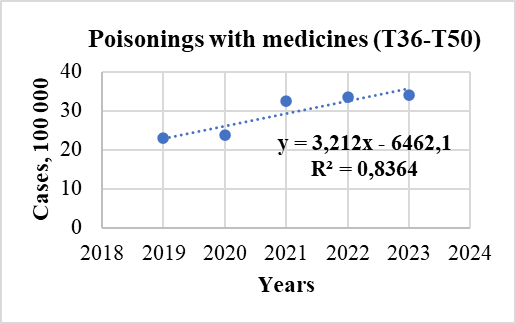 |
Fig. 1 Evolution of the incidence of acute medicinal poisonings and linear regression, 2019-2023 Note: R2 – coefficient of determination, y – linear regression. * The codes T36-T50 are part of the International Classification of Diseases, 10th Revision (ICD-10) [27], and refer to: T36-T50 — Poisoning by drugs, medicaments, and biological substances. |
In the case of acute alcohol poisoning (T51), the analysis of incidence and linear regression (y = -0.547x + 1118.2; R² = 0.1242) showed a decrease from 16.46 cases per 100,000 population in 2019 to 10.09 cases in 2021 (Fig. 2).
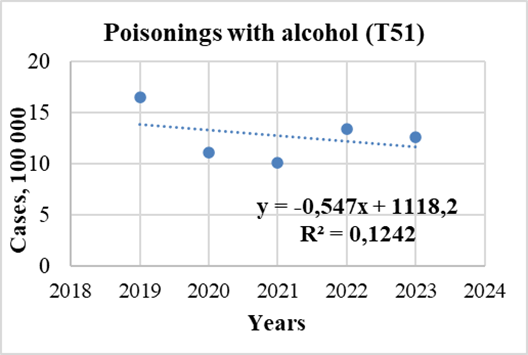 |
Fig. 2 Evolution of the incidence of acute alcohol poisoning and linear regression, 2019-2023 Note: R2 – coefficient of determination, y – linear regression. * The code T51 is part of the International Classification of Diseases, 10th Revision (ICD-10) [27], and refers to: T51 — Acute alcohol poisoning. |
During 2019-2023, acute non-occupational gas poisonings (T58) recorded a relatively stable trend (y = 0.798x - 1602.7, R2 = 0.3585), which indicates stagnation of the phenomenon (Fig. 3).
The incidence of acute pesticide poisoning (T60) ranged from 2.5 to 3.82 cases per 100,000 population, with a total incidence of 15.03 cases per 100,000, showing a moderate downward trend. This demonstrates the effectiveness of the regulatory measures regarding the management of phytosanitary products (pesticides), including preventive actions and educational initiatives in this area. However, the continued persistence of reported cases confirms the need to implement additional measures and improve access to information on the safe use and storage of pesticides (Fig. 4).
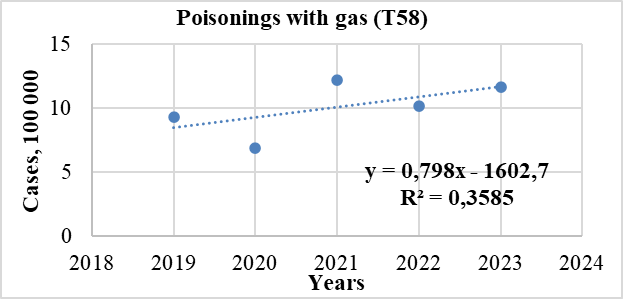 |
Fig. 3 Evolution of the incidence of acute gas poisonings and linear regression, 2019-2023 Note: R2 – coefficient of determination, y – linear regression. * The code T58 is part of the International Classification of Diseases, 10th Revision (ICD-10) [27], and refers to: T58 — Acute poisonings by gases. |
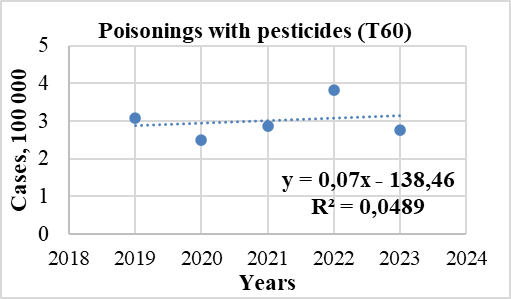 |
Fig. 4 Evolution of the incidence of acute pesticide poisoning and linear regression, 2019-2023 Note: R2 – coefficient of determination, y – linear regression. * The code T60 is part of the International Classification of Diseases, 10th Revision (ICD-10) [27], and refers to: T60 — Acute poisonings by pesticides. |
At the same time, the study identified the causes of ANCP, highlighting variations between children and adults. For example, in children, the main causes were natural curiosity (39%) and easy access to medicines, phytosanitary products (pesticides), and household products. An alarming proportion of 39% of ANCP cases in children were intentional or suicidal, often due to family conflicts or personal/emotional problems. In adults, chemical overdose was reported in 61% of cases, followed by suicidal poisoning (47.5%), and a low level of knowledge regarding the real risk of chemicals (22%), which confirms the need for educational and preventive measures in this area.
The economic analysis of the impact of ANCP during the 2019-2023 period highlighted a considerable volume of direct expenses generated by the treatment of patients intoxicated with potentially toxic chemical products, totaling 57,991,955.1 lei. Out of the total number of cases, 3,952 involved children under 18 years of age, with total expenditures amounting to 31,191,649.5 lei, while 5,627 cases involved adults aged 19 years and older, generating expenses of 26,800,305.56 lei.
Medicine poisonings were the most frequent and generated expenses of 22,436,099.1 lei, representing 39% of the total costs. Among children, 1,723 cases were recorded, generating 12,578,197.4 lei or 40.3% of the pediatric expenses. Among adults, 2,279 affected individuals accounted for 9,857,901.69 lei, representing 37% of total adult treatment costs.
Alcohol poisoning was reported in 1,798 cases, totaling 9,907,251.58 lei or 17.1% of the total expenditures. Children were affected in 529 cases, with expenditures of 3,511,060.57 lei, which constituted 11.3% of the expenditures for children. In adults, 1,269 cases were reported, with expenditures of 6,396,191.01 lei, or 23.9% of the total for adults.
In the gas poisoning category, 1,385 cases were registered, with 8,005,908.77 lei spent (13.8% of the total expenses). Of these, 510 cases occured in children, with a cost of 3,619,523.66 lei (11.6%), and 875 adults were affected, with expenses of 4,386,385.11 lei (16.4%).
Pesticide poisoning accounted for 417 cases and total expenses of 2,620,087.64 lei, representing 4.5% of the total expenses (Table 3).
Table 3. Medical expenses for ANCP in children and adults, 2019-2023 | |||||||||
Etiology | Total | Children | Adults | ||||||
n | Total expenditures, lei | % | n | Total expenditures, lei | % from the total in children | n | Total expenditures, lei | % from the total in adults | |
Medicines | 4,002 | 22,436,099.1 | 38.7 | 1,723 | 12,578,197.4 | 40.3 | 2,279 | 9,857,901.69 | 36.8 |
Alcohol | 1,798 | 9,907,251.58 | 17.1 | 529 | 3,511,060.57 | 11.3 | 1,269 | 6,396,191.01 | 23.9 |
Gas | 1,385 | 8,005,908.77 | 13.8 | 510 | 3,619,523.66 | 11.6 | 875 | 4,386,385.11 | 16.4 |
Pesticides | 417 | 2,620,087.64 | 4.5 | 144 | 1,373,480.62 | 4.4 | 273 | 1,246,607.02 | 4.7 |
Others | 1,977 | 15,022,608 | 25.9 | 1,046 | 10,109,387.3 | 32.4 | 931 | 4,913,220.73 | 18.3 |
Total per country | 9,579 | 57,991,955.1 | 100 | 3,952 | 31,191,649.5 | 100 | 5,627 | 26,800,305.56 | 100 |
Note: ANCP – acute non-occupational chemical poisoning, n –total absolute number of cases of acute non-occupational chemical poisoning. | |||||||||
During the 2021-2023 period, direct expenses for the treatment of patients hospitalized with ANCP in the Nephrology, Dialysis, and Toxicology Department of the “Holy Trinity” Municipal Clinical Hospital recorded an increase of 19.2%, from 1,232,514 lei in 2021 to 1,469,003 lei in 2023. The average cost per patient evolved from 4,449 lei to 5,421 lei, highlighting a possible increase in the severity of cases and therapeutic interventions. During this period, the largest shares in the expenditure structure were allocated for hospitalization, with 1,442,941 lei spent, and for medicines, with 860,165 lei. The average length of hospitalization increased from 1.7 days in 2022 to 2.0 days in 2023 (Table 4).
Table 4. Expenses incurred for the treatment of adults with ANCP at the "Holy Trinity" Municipal Clinical Hospital during the years 2021-2023 | ||||||||||
Year | Number of cases | Hospitalization | Alimentation | Medicines | Sanitary materials | Laboratory tests | Other investigations | TOTAL expenditures | Expenditures per person | Average |
2021 | 277 | 446,188 | 21,635 | 256,711 | 5,894 | 222,646 | 27,944 | 1,232,514 | 25,238 | 2.2 |
2022 | 236 | 320,450 | 17,850 | 214,556 | 12,040 | 202,657 | 303,098 | 1,070,651 | 25,808 | 1.7 |
2023 | 271 | 676,302.9 | 34,477 | 388,898 | 7,570 | 187,615 | 174,140 | 1,469,003 | 23,486 | 2.0 |
Total | 784 | 1,442,941 | 73,962 | 860,165 | 25,504 | 612,918 | 505,182 | 3,772,168 | 74,532 |
|
Note: ANCP – Acute non-occupational chemical poisoning | ||||||||||
In order to prevent and reduce cases of ANCP, NAPH specialists, in collaboration with public medical and health institutions and educational institutions, have developed practical and methodological guides and conducted annual awareness, education, and information campaigns in this field.
Discussions
The results of the study highlighted that ANCP continues to present a major burden to public health in the Republic of Moldova, affecting both the adult population and children. The analysis of statistical data demonstrated an incidence of acute poisonings of chemical origin more than twice as high among children, with average annual values of 130.6 cases per 100,000 population, compared to 52.2 cases in adults, reflecting their particular vulnerability. This is determined by the exploratory behavior of children, especially young ones, as well as by insufficient supervision, inadequate storage and use of potentially toxic chemicals, and easy access to medicines or household products.
Based on the estimation of the etiological factors, medicines were identified as the main cause of ANCP, a finding that corresponds to international trends reported in the specialized literature. This predominance reflects a deficit in the education and information of the population, including children, regarding the correct and safe management of chemical products under household conditions. Moreover, there is a need to develop and implement additional regulatory measures, including clear labeling, the promotion of secure packaging, and the establishment of stricter standards regarding the accessibility of medicines and other chemical products.
During the analyzed period (2019-2023), the persistence of cases of alcohol, gas, and pesticide poisoning was observed, reflecting accidental exposure due to a lack of awareness of the real risks associated with potentially toxic chemical substances or mixtures. This emphasizes the importance of continuing education and information campaigns in the field of ANCP, as well as prevention measures and first-aid training.
At the same time, the costs associated with the treatment of ANCP (approximately 58 million lei) demonstrate that they represent an economic burden for the public health system. To assess the financial impact of ANCP and justify investments in prevention, the cost-benefit analysis (CBA) method was applied. The analysis demonstrated a cost-benefit ratio of 4.8:1 in favor of prevention. This means that for every 1 lei invested in prevention measures, the health system saves 4.8 lei in direct costs of poisoning treatment. This result justifies the implementation of integrated preventive measures, including the creation of a toxicological information center. Investing in prevention is a superior economic strategy, not just a public health necessity. By preventing cases, direct medical expenses are substantially reduced.
Overall, the integration of preventive, educational, legislative, and psychosocial support measures will contribute significantly to the reduction or prevention of the incidence of ANCP and their economic impact in the Republic of Moldova.
Conclusions
The study demonstrated that children were significantly affected by ANCP, with an incidence twice as high as that in adults, highlighting their increased vulnerability.
During the 2019-2023 period in the Republic of Moldova, acute medicine poisonings predominated and generated the highest costs, reflecting an alarming upward trend.
The high costs borne by the healthcare system, especially for the treatment of poisoned children, indicate a major economic impact and pressure on available resources.
Data on the cost-benefit ratio favoring prevention highlight the need to implement additional preventive measures, strengthen public education, including among children, and reinforce inter-institutional collaboration through continuous and coordinated actions.
Competing interests
None declared.
Authors’ contributions
The authors participated in the design of the study and made significant contributions to the drafting of the manuscript. They critically reviewed the work and approved the final version of the manuscript.
Ethics approval
The study was approved by the Research Ethics Committee of the Nicolae Testemițanu State University of Medicine and Pharmacy of the Republic of Moldova, minutes no. 68 of 21.05.2018.
Patient consent
Obtained.
Acknowledgements and funding
No external funding.
Provenance and peer review
Not commissioned, externally peer reviewed.
Authors’ ORCID IDs
Tatiana Tonu – https://orcid.org/0000-0003-0051-9497
Iurie Pinzaru – https://orcid.org/0000-0001-5293-8410
Ludmila Goma – https://orcid.org/0000-0003-3865-0909
Natalia Daniliuc – https://orcid.org/0000-0003-1440-8704
References
Tonu T. Impactul economic al intoxicațiilor acute de etiologie chimică la adulți în Republica Moldova pentru anii 2019-2023 [Economic impact of acute chemical poisonings in adults in the Republic of Moldova for the years 2019-2023]. Arta Medica. 2024;(3):11-14. Romanian. doi: 10.5281/zenodo.14530355.
United Nations Environment Programme (UNEP). Global chemicals outlook II- From legacies to innovative solutions: Implementing the 2030 agenda for sustainable development, United Nations Environment Programme. 2019. Nairobi: UNEP; 2020 [cited 2021 May 30]. Available from: https://www.unenvironment.org/explore-topics/chemicals-waste/what-we-do/policy-and-governance/global-chemicals-outlook
Wang Z, Walker GW, Muir DCG, Nagatani-Yoshida K. Toward a global understanding of chemical pollution: a first comprehensive analysis of national and regional chemical inventories. Environ Sci Tech. 2020;54(5):25-34. doi: 10.1021/acs.est.9b06379.
Naidu R, Biswas B, Willett IR, Cribb J, Singh BK, Nathanail CP, et al. Chemical pollution: a growing peril and potential catastrophic risk to humanity. Environ Int. 2021;156:1-12. doi: 10.1016/j.envint.2021.106616.
Khamidulina KhKh. Zadachiprofilakticheskoi toksikologii v obespechenii bezopasnogo regulirovaniшa khimicheskikh veshchestv [Preventive toxicology tasks in provisionof safe chemical regulations]. [Occup Med Human Ecol]. 2015;(3):280-286. Russian.
Kyu HH, Stein CE, Pinto CB, Rakovac I, et al. Causes of death among children aged 5-14 years in the WHO European region: a systematic analysis for the Global Burden of Desease Study 2016. Lancet Child Adolesc Health. 2018;2(5):321-337. doi: 10.1016/S2352-4642(18)30095-6.
Mintegi S, Azkunaga B, Prego J, et al. International epidemiological differences in acute poisoning in pediatric emergency departments. Pediatr Emerg Care. 2019;35(1):50-57. doi: 10.1097/PEC.0000000000001031.
Bulut M, Alemda D, Bulut A, Tekin E, Çelikkalka K. Evaluation of accidental and intentional pediatric poisoning: retrospective analysis in an emergency department of Turkey. J Pediatr Nurs. 2022;63:44-49. doi: 10.1016/j.pedn.2021.10.015.
Rajabali F, Turcotte K, Zheng A, Purssell R, Buxton J, Pike I. The impact of poisoning in British Columbia: a cost analysis. CMAJ Open. 2023;11(1):160-168.doi: 10.9778/cmajo.20220089.
Soave PM, Curatola A, Ferretti S, Raitano V, Conto G, Gatto A, Chiaretti A. Acute poisoning in children admitted to pediatric emergency department: a five-years retrospective analysis. Acta Biomed. 2022;93(1):e2022004. doi: 10.23750/abm.v93i1.11602.
Peden M, Oyegbite K, Ozanne-Smith J, et al., editors; World Health Organization. World report on child injury prevention. Geneva: WHO, 2008 [cited 2020 Oct 21]. Available from: https://iris.who.int/bitstream/handle/10665/43851/9789241563574_eng.pdf?sequence=1
Tonu T. Prevenirea riscurilor chimice pentru sănătatea populației prin desfășurarea Campaniilor de promovare a sănătății [Prevention of chemical health risks for the population through the implementation of health promotion campaigns]. Arta Medica. 2020;(4):31-33. Romanian. doi: 10.5281/zenodo.4173639.
Vilaça L, Volpe FM, Ladeira RM. Accidental poisoning in children and adolescents admitted to a referral toxicology department of a Brazilian emergency hospital. Rev Paul Pediatr. 2019;38:e2018096. doi: 10.1590/1984-0462/2020/38/2018096.
Descamps AM, Vandijck DM, Buylaert WA, Mostin MA, Paepe P. Characteristics and costs in adults with acute poisoning admitted to the emergency department of a university hospital in Belgium. PLoS One. 2019;4(10):e0223479. doi: 10.1371/journal.pone.0223479.
Kaya E, Yilmaz A, Saritas A, Colakoglu S, Baltaci D, Kandis H, et al. Acute intoxication cases admitted to the emergency department of a university hospital. World J Emerg Med. 2015;6(1):54-59. doi: 10.5847/wjem.j.1920-8642.2015.01.010.
Krajewsk AK, Friedman LS. Hospital outcomes and economic costs from poisoning cases in Illinois. Clin Toxicol (Phila). 2015;53(5):433-445. doi: 10.3109/15563650.2015.1030677.
Fernando SM, Reardon PM, Ball IM, et. al. Outcomes and costs of patients admitted to the intensive care unit due to accidental or intentional poisoning. J Intensive Care Med. 2020;35(4):386-393. doi: 10.1177/0885066617754046.
Buendía JA, Chavarriaga GJ. Cost of illness of paraquat poisoning in Colombia. Value Health Reg Issues. 2019;20:110-114. doi: 10.1016/j.vhri.2019.02.006.
Yenew C, Shewaye M, Yeshiwas AG, Gebeyehu AA. Burden of chemical poisoning and contributing factors in the case of the Amhara Region, Ethiopia. BMC Public Health. 2024;24(1):2650. doi: 10.1186/s12889-024-20190-9.
Jain P, Mehta R, Sharma A. Organophosphate poisoning: epidemiology, clinical features, and management. Clin Toxicol. 2023;61(5):489-502.
Desai MM, Patel KK, Gupta R. Risk factors and outcomes of chemical poisoning: an updated analysis. Int J Environ Health Res. 2023;33(4):556-70.
World Health Organization. Live life: an implementation guide for suicide prevention in countries. Geneva: WHO; 2021 [cited 2025 May 12]. Available from: https://iris.who.int/bitstream/handle/10665/341726/9789240026629-eng.pdf?sequence=1
Stricka M, Jakubauskiene M. Suicide prevention: a case of Lithuania. Eur J Public Health. 2016;26(1 Suppl). doi: 10.1093/eurpub/ckw169.042.
Ramos-Martin J, Contreras-Peñalver MA, Moreno-Küstner B. Classification of suicidal behavior calls in emergency medical services: a systematic review. Int J Emerg Med. 2023;16(1):27. doi: 10.1186/s12245-023-00504-1.
World Health Organization. Suicide in the world: global health estimates. Geneva: WHO; 2019 [cited 2025 May 12]. Available from: https://apps.who.int/iris/handle/10665/326948.
Biroul Național de Statistică al Republicii Moldova [National Bureau of Statistics of the Republic of Moldova]. Populația și procesele demografice [Population and demographic processes]. Chisinau: NBS; 2025- [cited 2025 Jun 20]. Available from: https://statistica.gov.md/ro/statistic_indicator_details/25.
National Centre for Health Classification (Sydney). Clasificarea internațională și statistică a bolilor și problemelor de sănătate înrudite, revizia 10, modificarea australiană (ICD-10-AM). Lista tabelară a bolilor ICD-10-AM. Vol. 1 [International statistical classification of diseases and related health problems, 10th Revision, Australian modification (ICD-10-AM). ICD-10-AM Tabular list of diseases, Vol. 1]. Sydney: NCHC; 2002 [cited 2025 May 12]. Available at: https://www.drg.ro/DocDRG/ListaTabelara_Boli_ICD_10_AM.pdf. Romanian.