Heart failure with preserved ejection fraction (HFpEF) accounts for nearly half of all heart failure cases and is frequently associated with cardiovascular and metabolic comorbidities. The phenotype of HFpEF patients is heterogeneous, and the impact of comorbidities on prognosis, exercise capacity, and functional status remains insufficiently elucidated.
Current issue
Volume
13.
Issue
2
June, 2026
most recent article
Non-immune fetal hydrops and intestinal obstruction: rare manifestations of congenital syphilis
Fetal hydrops is defined as the pathological accumulation of extracellular fluid in at least two fetal anatomical compartments, including skin edema (> 5 mm thickness), pericardial effusion, pleural effusion, and ascites. Non-immune fetal hydrops (NIHF) accounts for over 90% of all fetal hydrops cases and has a heterogeneous etiology. Congenital infections contribute to approximately 6–7% of NIHF cases and are associated with a severe neonatal prognosis.
Recent articles
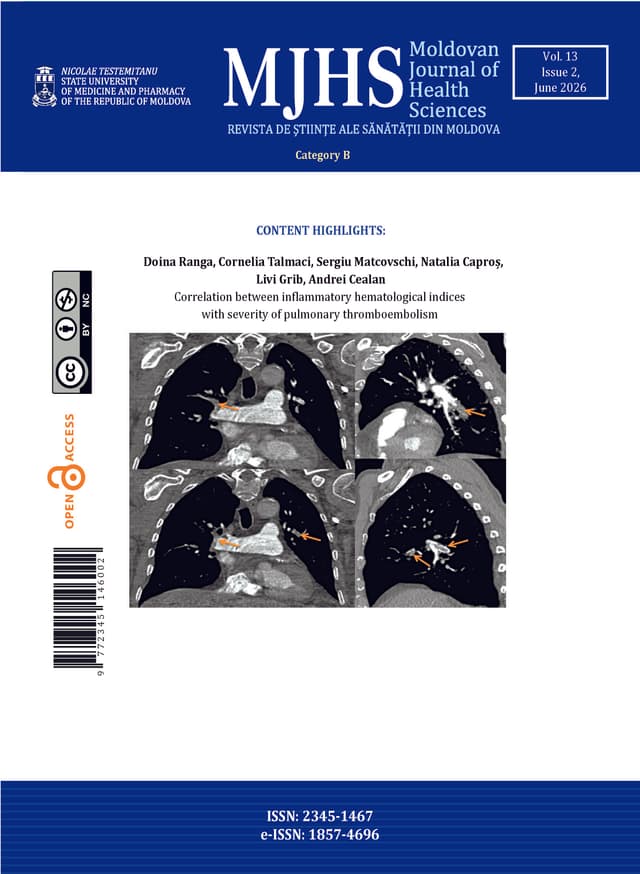
Pulmonary thromboembolism (PTE) is a major cardiovascular emergency associated with significant mortality. Systemic inflammation contributes to the pathogenesis of thrombosis and to disease severity, and hematological indices derived from the complete blood count, such as the neutrophil-to-lymphocyte ratio (NLR) and the platelet-to-lymphocyte ratio (PLR), have been proposed as prognostic predictors.
Inflammation is a state driven by pathogenic stimuli. Trauma is one of the causes of acute onset of the inflammatory pathway. Multiple proteases are capable of inducing distant multiple organ lesions (lungs, brain or spinal cord, heart, kidney, liver and systemic vessel endothelium). The onset of corresponding syndromes will complicate the clinical course of that particular patient. These molecules are potential biomarkers in trauma patients.
Introduction. Circadian rhythms are endogenous, approximately 24-hour oscillations that coordinate nearly all physiological systems, including cardiovascular function. The suprachiasmatic nucleus serves as the central pacemaker, synchronizing peripheral clocks in the heart, vasculature, and kidneys to generate daily fluctuations in blood pressure, heart rate, endothelial function, coagulation, myocardial metabolism, and autonomic tone. Disruption of circadian organization – through extrinsic factors (shift work, irregular light exposure, altered feeding schedules) or intrinsic factors (aging, inflammation, genetic clock-gene variants) – has been strongly linked to increased cardiovascular morbidity and mortality.
Material and methods. A bibliographic search was conducted in PubMed, Scopus, and Web of Science for English-language publications (2000–2025), focusing on the circadian rhythm, cardiovascular disease, hypertension, chronotherapy, and critical illness. Keywords included “circadian rhythm,” “cardiovascular disease,” “hypertension,” “chronotherapy,” and “intensive care.” Original research, clinical trials, meta-analyses, and experimental studies were eligible; studies addressing circadian blood pressure variability and its relation to outcomes in critically ill patients were specifically examined. Filters required full-text availability and publication dates from 2000 to 2025. The search yielded 276 full-text articles, of which 79 representative sources were selected for this narrative review.
Results. This review synthesizes current evidence demonstrating that circadian clocks regulate essential cardiovascular processes and that their disruption contributes to disease pathogenesis. Observational data on circadian blood pressure variability are discussed, showing that the attenuation of normal hemodynamic oscillations is associated with a worse prognosis. Particular attention is given to the extrinsic and intrinsic factors that modulate circadian alignment, with implications for the management of patients in intensive care.
Fetal hydrops is defined as the pathological accumulation of extracellular fluid in at least two fetal anatomical compartments, including skin edema (> 5 mm thickness), pericardial effusion, pleural effusion, and ascites. Non-immune fetal hydrops (NIHF) accounts for over 90% of all fetal hydrops cases and has a heterogeneous etiology. Congenital infections contribute to approximately 6–7% of NIHF cases and are associated with a severe neonatal prognosis.