
Introduction
Dental caries (DC) is a major oral health problem worldwide and in the Republic of Moldova [1, 2]. The degree of DC prevalence is one of the key indicators of the population’s health status and the effectiveness of medical and dental care in the country [3]. Reported since ancient times, and alongside the progress of civilization, the prevalence of DC in the population has increased significantly [3, 4]. Dental caries is considered the disease with the longest evolution period in human life, occurring with high prevalence and incidence in all regions of the globe, giving it an endemic-epidemic character [1, 2]. Despite scientific advancements and modern dental equipment, the prevalence and incidence of DC among the growing population of our country remain high, with no apparent trends toward reducing morbidity indicators [5].
DC and its complications influence the development of the dento-maxillary apparatus through the effect of both simple and complicated caries, often resulting in early tooth loss [6]. Treatment of dental caries in young children is frequently neglected for various reasons, and the impact of untreated caries is manifested not only through pain, sleep disturbances, and odontogenic infections but can also adversely affect the child’s growth and development [7, 8].
It is known that oral fluid (OF) plays an important role in maintaining oral health due to its immunological and non-immunological components, such as antimicrobial proteins and enzymes [9]. In recent years, research has focused on identifying salivary biomarkers associated with the onset and progression of DC, including zinc (Zn), antimicrobial peptides (especially LL-37), and immunoregulatory cytokines such as transforming growth factor beta-1 (TGF-β1) [10]. Zn has been shown to inhibit enamel demineralization by approximately 49% through its ability to reduce acid production in the dental biofilm by inhibiting glucose transferase [11]. Experimental studies have also demonstrated that adequate Zn intake can stimulate the expression of these protective factors, thereby contributing to the prevention of DC [12, 13]. LL-37 is a cathelicidin produced by epithelial cells and neutrophils, acting as a broad-spectrum antimicrobial agent and modulator of inflammation. Studies in children of various ages by Almoudi et al. (2021) reported a negative correlation between LL-37 levels and the severity of DC [14, 15], as well as a positive relationship with salivary pH and salivary flow [15]. Conversely, no association has been observed between TGF-β1 content in OF and the extent of DC-related damage [16].
Thus, a large number of studies have demonstrated that OF biomarkers can be used to diagnose several oral diseases, including DC. However, not all biomarkers have the same degree of accuracy, and currently only some of them have been proven reliable. The use of combined biomarkers, on the other hand, could have higher accuracy compared to the use of isolated biomarkers [14-16]. Therefore, it is relevant to study the dynamics of OF biomarkers to develop individualized, accurate quantitative parameters for personalized caries risk assessment and DC prediction.
The aim of the research is to study the relationship between the levels of zinc (Zn), the antimicrobial peptide LL-37, and transforming growth factor beta-1 (TGF- β1) in oral fluid and the incidence of dental caries in children.
Material and methods
To achieve the purpose of the work, a prospective observational cohort study was conducted. This study included 398 conventionally healthy children aged between 3 and 15 years, who were divided into two groups. The examined children were from urban areas (196; 49.2%) and rural areas (202; 50.8%).
The research group (L1, caries group) consisted of 132 children with carious lesions (33.2%, 95% CI 29-38), while 266 caries-free children (66.8%, 95% CI 62-71) formed the control group (L0,caries-free group). All subjects were native to and residents of the Republic of Moldova. The distribution of children into age groups followed the target groups recommended by the World Health Organization (WHO) [17]: 3, 6, 12, and 15 years old. The 3-year-old group included 98 children (24.6%, 95% CI 20-29), the 6-year-old group 90 children (22.6%, 95% CI 19-27), the 12-year-old group 102 children (25.6%, 95% CI 21-30), and the 15-year-old-group 108 children (27.1%, 95% CI 23-32). Subjects were evenly distributed by gender: 199 girls (50.0%, 95% CI 45-55) and 199 boys (50.0%, 95% CI 45-55). Of all children examined, 196 (49.2%, 95% CI 44-54) came from urban areas, and 202 (50.8%, 95% CI 46-56) from rural areas. Therefore, the children in both groups lived under similar socio-economic conditions, and the distribution of subjects in groups L1 and L0 was proportional according to age, gender, and living environment.
Table 1. General characteristics of the studied cohort | ||
Variable | N = 398 | 95% CI |
Group |
|
|
caries research group (L1) | 132 (33.2%) | 29%, 38% |
caries-free control group (L0) | 266 (66.8%) | 62%, 71% |
Age |
|
|
3 | 98 (24.6%) | 20%, 29% |
6 | 90 (22.6%) | 19%, 27% |
12 | 102 (25.6%) | 21%, 30% |
15 | 108 (27.1%) | 23%, 32% |
Gender |
|
|
female | 199 (50.0%) | 45%, 55% |
male | 199 (50.0%) | 45%, 55% |
Area |
|
|
rural | 202 (50.8%) | 46%, 56% |
urban | 196 (49.2%) | 44%, 54% |
Note: N - total number of patients and relative frequencies; 95% CI – 95% Confidence Interval | ||
A clinical examination of the children was performed, and OF was collected to assess the levels of Zn, TGF-β1, and LL-37. Data collection was conducted using the WHO Oral Health Questionnaire for Children (2013) to record oral status. The degree of DC damage was assessed by calculating caries experience indices: the DC prevalence index (PI) and indices reflecting DC severity, including dmft/DMFT and dmfs/DMFS [17]. The DMFT/dmft index represents the sum of carious permanent or primary teeth extracted due to caries and restored. The DMFS/dmfs index represents the sum of carious surfaces extracted due to caries and restored in permanent or primary teeth. The mean values of the DMFT/dmft and DMFS/dmfs indices were estimated by dividing these indices by the total number of subjects in the research and control groups. To achieve the complex and personalized prediction of DC, Cariogram software was used [18].
Biochemical studies of OF included the determination of Zn, transforming growth factor beta-1 (TGF- β1), and antimicrobial peptide LL-37 levels in all children included in the study. OF was collected unstimulated, in the morning, on an empty stomach, in sterile plastic tubes that were subsequently transported to the Scientific Laboratory of Biochemistry of the Nicolae Testemițanu State University of Medicine and Pharmacy. OF analysis was performed without dilution, with all stages of the study carried out according to the manufacturers’ instructions.
Determination of Zn levels in OF was performed using ELISA Total-Microtiter Plates kits (Epitope Diagnostics). The analysis and detection of cathelicidin LL-37 peptide were performed using ELISA kits (enzyme-linked immunosorbent assay). Assessment of the TGF-β1 level in OF was performed using ELISA kits (Human TGF beta1 ELISA set, BD Biosciences).
The study was conducted in compliance with the principles of the Declaration of Helsinki and was approved by the Research Ethics Committee of Nicolae Testemițanu State University of Medicine and Pharmacy, number 17 dated 02.06.2015.
The data were processed automatically using the open-source software RStudio, version 2024.09.1+394 (https://www.rstudio.com). The use of these modern tools, widely recognized in academic and research environments, enabled rigorous, efficient, and fully reproducible analysis of the dataset. Their selection played a crucial role in ensuring the transparency of the analytical process, the validity of the results, and the potential for independent replication. The source code used for data preprocessing and analysis is available and can be provided upon request, offering the opportunity for verification of results or integration of the methodology in future related research.
To describe the numerical variables, fundamental descriptive statistics were computed: minimum and maximum values, arithmetic mean with standard deviation, median (Me), and interquartile range (IQR). These measures of central tendency and dispersion provided a detailed and precise depiction of the distribution of each variable, facilitating the identification of outliers, potential skewness, and deviations from normality. For comparing two independent groups with respect to the distribution of quantitative variables, the non-parametric Mann-Whitney-Wilcoxon test was applied, given its robustness and insensitivity to non-Gaussian distributions or extreme values.
Graphical representations of numerical variables were generated using box plots, complemented by jitter plots and violin plots, offering an intuitive visualization of central tendencies, variability, and group differences.
For categorical variables, both absolute and relative frequencies were calculated, accompanied by 95% confidence intervals for proportion estimates. This approach enabled a robust statistical characterization of category-level distributions. To test hypotheses related to categorical variables, Pearson’s Chi-squared test was used. In all cases, regardless of sample size or frequency distribution, the Monte Carlo simulation method was employed, generating 100,000 random samples to ensure a robust estimation of the p-value. This approach was chosen to maintain the validity of statistical inference even in situations with small cell counts or imbalanced group sizes.
Additionally, linear regression analysis was performed to further explore associations between variables and to quantify the magnitude of the observed effects.
All statistical analyses were conducted using a conventional significance level (α) of 0.05. Results were interpreted accordingly: p-values below this threshold were considered statistically significant. The practical and clinical relevance of the findings was further evaluated in the context of the present study, taking into account the observed effect sizes and their potential implications for public health decisions or clinical interventions.
Results
The evaluation of the results regarding the degree of damage caused by DC at the beginning of the study showed that in children from the research group (L1), the values of the caries experience indicators were 4.00 (Me, IQR = 3.25) for the dmft/DMFT index and 8.00 (Me, IQR = 7.00) for the dmfs/DMFS index (Wilcoxon rank sum test = 35,112, padjusted < 0.001) (Table 2).
Table 2. Values of caries experience indices in children | |||||||
|---|---|---|---|---|---|---|---|
Variables | Caries group (L1) N = 132 | 95% CI | Caries-free group (L0) N = 266 | 95% CI | Wilcoxon rank sum test | p-value | q-value |
DMFT/ dmft | 4.74 (2.65) | 4.3, 5.2 | 0.00 (0.00) | 0, 0 | 35,112 | <0.001 | <0.001 |
DMFS/ dmfs | 8.06 (4.91) | 7.2, 8.9 | 0.00 (0.00) | 0, 0 | 35,112 | <0.001 | <0.001 |
Note: DMFT: D-Decay, M-Missing, F-Filled, T-Tooth; dmft: d-decay, m-missing, f-filled, t-tooth; DMFS: D-Decay, M-Missing, F-Filled, S-Surfaces; dmft: d-decay, m-missing, f-filled, s-surfaces; N-number of patients; CI-Confidence Interval (for L0, only one point zero); Statistical test: Wilcoxon rank sum test; p-value - probability of obtaining results as extreme as the observed ones, or more extreme, assuming that the null hypothesis is true; q-value – p value Hochberg correction for multiple testing. | |||||||
The complex and personalized prediction of DC using the Cariogram software highlighted a moderate caries risk in children with carious lesions, the chances of avoiding new carious cavities being 53.00% (Me, IQR = 19.50). In caries-free children, the chances of avoiding new carious cavities were 82.00% (Me, IQR = 18.00), the caries risk being low. A significant difference was detected between the groups of children L1 and L0, (Wilcoxon rank sum test = 3.171, padjusted <0.001) (Figure 1).
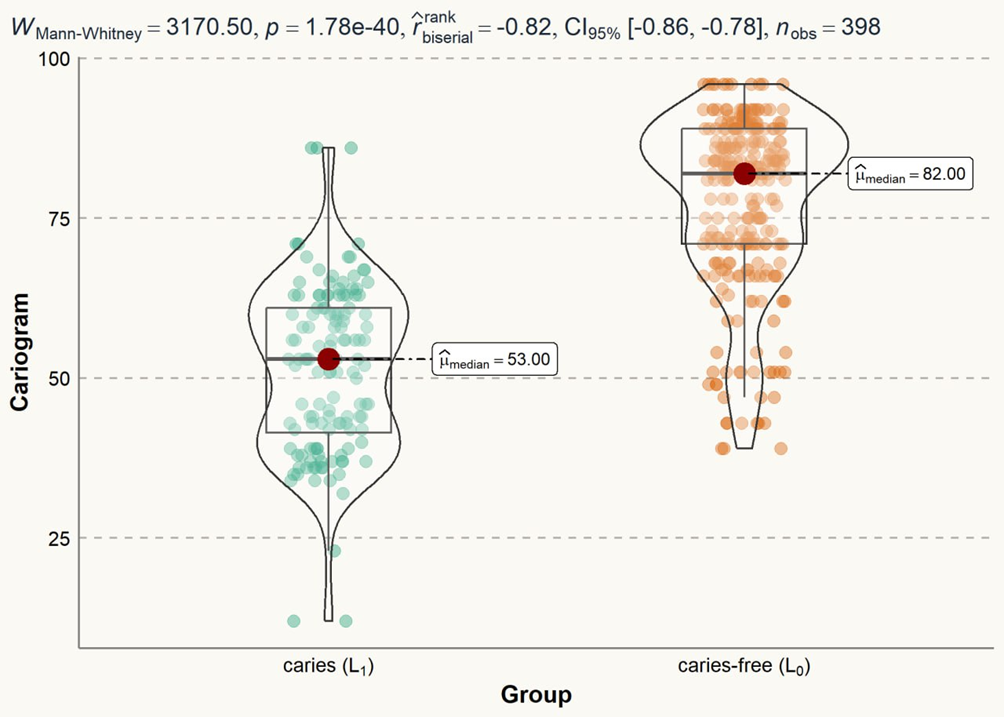 |
Fig. 1 Chances of avoiding new carious cavities estimated using the Cariogram software in children with dental caries and caries-free children. Note: WMann-Whitney = 3170.50 - Wilcoxon rank sum test value; CI - Confidence Interval, nobs – number of research and control groups; n - number of patients; caries (L1) - research group; caries-free (L0) - control group. |
The results obtained from the clinical examination and DC prediction, confirmed by the study of the salivary biomarker complex (Zn, TGF-β1, and LL-37), are presented in Table 3.
Table 3. Values of immune system biomarkers in oral fluid in children | |||||||
|---|---|---|---|---|---|---|---|
Variables | Caries group (L1) N = 132 | 95% CI | Caries-free group (L0) N = 266 | 95% CI | Wilcoxon rank sum test | p-value | q-value |
Zinc | 22.43 (7.35) | 21, 24 | 39.40 (16.51) | 37, 41 | 5,574 | <0.001 | <0.001 |
LL-37, ng/mL | 6.66 (2.86) | 6.2, 7.1 | 8.59 (2.31) | 8.3, 8.9 | 7,047 | <0.001 | <0.001 |
TGF-β1, pg/mL | 0.35 (0.21) | 0.32, 0.39 | 0.50 (0.26) | 0.47, 0.53 | 11,048 | <0.001 | <0.001 |
Note: LL-37-antimicrobial peptide; TGF-β1- transforming growth factor beta-1; N-number of patients; CI- Confidence Interval; Statistical test: Wilcoxon rank sum test; p-value - probability of obtaining results as extreme as the observed ones, or more extreme, assuming that the null hypothesis is true; q-value – p value Hochberg correction for multiple testing. | |||||||
In the OF of children with carious lesions (L1), significantly reduced levels of TGF-β1 were detected: 0.31 (Me, IQR = 0.27) pg/mL, compared to caries-free children, 0.44 (Me, IQR = 0.32) pg/mL (Wilcoxon rank sum test = 11,048 padjusted = 0.001). The assessment of LL-37 in the OF of children affected by DC revealed low values of this antimicrobial peptide – 6.45 (Me, IQR = 1.48) ng/mL, compared to caries-free subjects, 8.85 (Me, IQR = 2.88) ng/mL, the difference being statistically significant (Wilcoxon rank sum test = 7,047, padjusted = 0.001).
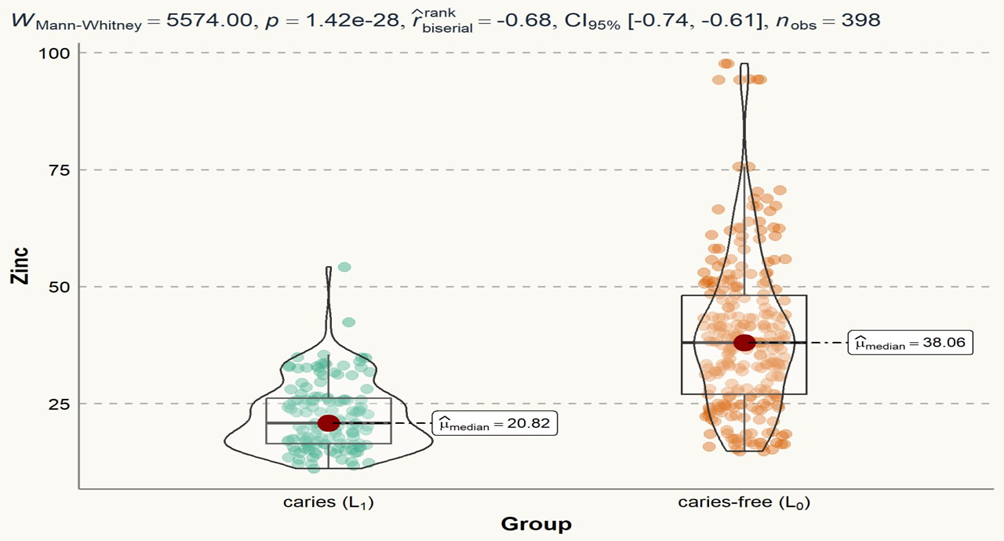 |
Fig. 2 Zinc levels in oral fluid in children. Note: WMann-Whitney = 5,574 - Wilcoxon rank sum test value; CI-Confidence Interval, nobs – number of research and control groups; n - number of patients; caries (L1) - research group; caries-free (L0) - control group. |
Figure 2 shows the results of the assessment of Zn levels in the OF of children. In children affected by DC, a statistically significant lower level of Zn in OF was detected: L1 = 20.83 (Me, IQR = 9.73) pg/mL, compared to subjects in the control group, L0 = 38.07 (Me, IQR = 21.08) pg/mL (Wilcoxon rank sum test = 5,574, padjusted = 0.001).
Discussion
OF represents a very well-organized, specific biological environment with unique and universal properties. It is a dynamic medium that reflects all changes occurring in the body, including those associated with carious disease. Due to its characteristics, OF is considered a valuable tool in the diagnosis of DC and offers multiple advantages as a diagnostic method: it allows better acceptance and cooperation from anxious patients [11], as well as rapid, simple, and non-invasive identification of biomolecules with the potential to improve early diagnosis, prognosis, monitoring of disease evolution, and assessment of the effectiveness of applied treatments [11, 19].
In the present study, significantly reduced levels of Zn, LL-37, and TGF-β1 were detected in the OF of children with carious lesions. Our results are consistent with those of previous research by Ajeel N.A. et al. (2024) [20]. The authors argue that the multifunctional cytokine TGF-β1 is one of the main regulators of the immune response, possesses strong anti-inflammatory properties, and inhibits the production of other pro-inflammatory cytokines [16]. It is assumed that the physiological function of TGF-β1 in odontoblasts is related to tooth mineralization [12]. It has also been suggested that TGF-β1 participates in the antimicrobial protection of the tooth, although this mechanism is not yet fully elucidated.
Several studies have obtained similar results, showing lower levels of LL-37 in the saliva of subjects with high caries activity compared to caries-free children [13, 16]. LL-37 has previously been shown to prevent biofilm formation on tooth surfaces, inhibit the growth and colonization of Streptococcus mutans [21], reduce the thickness of existing biofilms and the adhesion of microorganisms to the tooth surface, thereby decreasing the production of inflammatory markers [13, 21, 22], and to enhance the antimicrobial capacity of anti-inflammatory cells such as neutrophils [14, 15, 21].
The analysis of the results of the present study revealed significantly lower levels of Zn in the OF of children with carious lesions. We believe that Zn deficiency led to a decrease in the levels of the immunoregulatory proteins TGF-β1 and LL-37 in the OF, which resulted in a rapid and severe evolution of the carious process in children of different ages, as confirmed by the low chances of avoiding new carious cavities estimated using the Cariogram software. At the same time, significantly higher values of Zn in the OF were observed in children free from DC. These results suggest that Zn may exert a protective role, possibly through its direct antibacterial action and by stimulating the production of the immunoregulatory molecules TGF-β1 and LL-37, and confirm the results of studies conducted by Talukder, P. et. al, 2011 and Morio K.A. et al., 2023 [12, 13]. Our results are also consistent with the study conducted by Sharma A. and Subramaniam P., 2021, which demonstrated the ability of Zn to inhibit glucosyltransferase and block dental biofilm formation [23].
Thus, the results obtained in the present study established that the increased levels of Zn, TGF-β1, and LL-37 in OF in caries-free children indicate that these components have an important role in maintaining oral microbial homeostasis and in preventing the occurrence of DC, as confirmed by the increased chances of avoiding new carious cavities estimated using Cariogram software (82.00%), the caries risk being low. Therefore, the combined use of Zn, TGF-β1, and LL-37 biomarkers in OF may ensure higher accuracy, with greater sensitivity and specificity for the personalized prognosis of DC in children. The results obtained support the further development of personalized approaches in the early diagnosis and prediction of DC, based on the biochemical profile of OF.
Conclusions
In children affected by dental caries, significantly decreased levels of Zn, LL-37, and TGF-β1 were found in OF, compared to the balanced levels of these biomolecules in the OF of caries-free children. Low levels of Zn, LL-37, and TGF-β1 in OF may be an indicator of rapid progression of DC, a fact that needs to be taken into account when planning individualized preventive measures.
The combined assessment of OF biomarkers represents a non-invasive and innovative method for DC prognosis, with higher sensitivity and specificity. However, for the clinical use of OF biomarkers, it is necessary to develop standardized protocols and conduct large studies in which the influence of various confounding variables is controlled.
Competing interest
None declared.
Contribution of authors
SP conceived the study, participated in its design, performed the statistical analysis, and drafted the manuscript. OT consulted on the study design, processing of oral fluid samples, assessment of Zn levels and immunological biomarkers, interpreted the results, and contributed to the drafting of the manuscript. AS participated in the study design, interpreted the results, and guided the drafting of the manuscript. All authors critically reviewed the paper and approved the final version of the manuscript.
Ethics approval
The study was conducted as part of a doctoral research project approved by the Committee of Research Ethics of Nicolae Testemițanu State University of Medicine and Pharmacy (Minutes No.17, dated 02.06.2015).
Patient consent
Obtained.
Acknowledgements and funding
No external funding.
Provenance and peer review
Not commissioned; externally peer-reviewed.
Authors’ ORCID IDs
Svetlana Plamadeală –https://orcid.org/0000-0001-9800-5739
Olga Tagadiuc – https://orcid.org/0000-0002-5503-8052
Aurelia Spinei –https://orcid.org/0000-0001-9800-5739
References
Banakar M, Fernandes GVO, Etemad-Moghadam S, Frankenberger R, Pourhajibagher M, Mehran M, et al. The strategic role of biotics in dental caries prevention: a scoping review. Food Sci Nutr. 2024;12(11):8651-8674. doi: 10.1002/fsn3.4473.
Petersen PE, Baez RJ, Ogawa H. Global application of oral disease prevention and health promotion as measured 10 years after the 2007 World Health Assembly statement on oral health. Community Dent Oral Epidemiol. 2020;48(4):338-348. https://doi.org/10.1111/cdoe.12538.
Spinei A. Oportunități în prevenirea cariei dentare la copii cu dizabilități [Opportunities in preventing dental caries in children with disabilities] [dissertation]. Chisinau: Nicolae Testemițanu State University of Medicine and Pharmacy; 2018. Romanian.
Spinei A, Bălteanu O, Plamadeală S, Hristea E, Spinei I, Tagadiuc O. Relaţia dintre afectarea prin carie dentară și particularităţile metabolismului fosfocalcic la copiii cu maladii severe ale sistemului nervos central provocate de hipoxia perinatală = Relationship between dental caries and phosphocalcic metabolism in children with severe central nervous system diseases caused by perinatal hypoxia. Med Stomatol (Chisinau). 2022;(1):67-83. Romanian, English. https://doi.org/10.53530/1857-1328.22.61.09
Spinei A. Nivelul imunoglobulinelor în fluidul oral și serul sanguin la copiii cu maladii severe ale sistemului nervos central [Level of immunoglobulins in the oral fluid and blood serum of children with severe diseases of the central nervous system]. Med Stomatol (Chisinau). 2016(3):52-59. Romanian.
Trifan V. Unele aspecte medico-sociale caracteristice copiilor cu afecţiuni ale cavităţii bucale din Republica Moldova [Some medical aspects specific for children with oral cavity diseases in the Republic of Moldova]. Curierul Med (Chisinau). 2014;57(6):14-19. Romanian.
Gunay B, Kaya MS, Ozgen IT, Guler EM, Kocyigit A. Evaluation of the relationship between pain infammation due to dental caries and growth parameters in preschool children. Clin Oral Investig. 2023;27(7):3721-3730. doi: 10.1007/s00784-023-04988-2.
Moriyama CM, Velasco SRM, Butini L Abanto J, Antunes JLF, Bönecker M. How oral health literacy and parental behavior during the meals relate to dental caries in children. Braz Oral Res. 2022;36:e131. doi: 10.1590/1807-3107bor-2022.vol36.0131.
Razi MA, Qamar S, Singhal A, Mahajan A, Siddiqui S, Mohina Minz RS. Role of natural salivary defenses in the maintenance of healthy oral microbiota in children and adolescents. J Family Med Prim Care. 2020 9(3):1603-1607. doi: 10.4103/jfmpc.jfmpc_1134_19.
Horst OV, Tompkins KA, Coats SR, Braham PH, Darveau RP, Dale BA. TGF-beta1 Inhibits TLR-mediated odontoblast responses to oral bacteria. J Dent Res. 2009 Apr;88(4):333-8. doi: 10.1177/0022034509334846.
Spinei A, Picos AM, Romanciuc I, Berar A, Mihailescu AM. The study of oral liquid microcrystallization in children with gastro-esophageal reflux disease. Clujul Med. 2014;87(4):269-276. https://doi.org/10.15386/cjmed-387.
Morio KA, Sternowski RH, Brogden KA. Induction of endogenous antimicrobial peptides to prevent or treat oral infection and inflammation. Antibiotics (Basel). 2023;12(2):361. https://doi.org/10.3390/antibiotics12020361.
Talukder P, Satho T, Irie K, Sharmin T, Hamady D, Nakashima Y, et al. Trace metal zinc stimulates secretion of antimicrobial peptide LL-37 from Caco-2 cells through ERK and p38 MAP kinase. Int Immunopharmacol. 2011;11(1):141-144. doi: 10.1016/j.intimp.2010.10.010.
Almoudi MM, Hussein AS, Abu-Hassan MI, Saripudin B, Mohamad MSF. The association of early childhood caries with salivary antimicrobial peptide LL-37 and mutans streptococci. J Clin Pediatr Dent. 2021;45(5):330-336. doi: 10.17796/1053-4625-45.5.7.
Yousif SH, Qasim AA. Salivary cathelicidins (LL-37) as a dental caries biomarker in relation to nutrition status among a group of adolescents. World J Dent. 2023;14(4):352-358. https://doi.org/10.5005/jp-journals-10015-2223.
Angarita-Díaz MP, Simon-Soro A, Forero D, Balcázar F, Sarmiento L, Romero E, Mira A. Evaluation of possible biomarkers for caries risk in children 6 to 12 years of age. J Oral Microbiol. 2021;13(1):1956219. https://doi.org/10.1080/20002297.2021.1956219.
Petersen PE, Baez RJ; World Health Organization. Oral health surveys: basic methods [Internet]. 5th ed. Geneva: WHO; 2013 [cited 2024 Nov 5]. Available from: https://iris.who.int/bitstream/handle/10665/97035/9789241548649_eng.pdf…
Bratthall D, Hänsel Petersson G. Cariogram – multifactorial risk assessment model for multifactorial disease. Community Dent Oral Epidemiol. 2005;4(33):256-264. https://doi.org/10.1111/j.1600-0528.2005.00233.x.
Silveira EG, Prato LS, Pilati SFM, Arthur RA. Comparison of oral cavity protein abundance among caries-free and caries-affected individuals – a systematic review and meta-analysis. Front Oral Health. 2023;4:1265817. doi: 10.3389/froh.2023.1265817.
Ajeel NA, Diab BS. Dental caries as a health risk for visual acuity in relation to salivary transforming growth factor beta-1 among students aged 8-10 years: a cross-sectional study. J Int Soc Prev Community Dent. 2024 Apr 29;14(2):144-151. doi: 10.4103/jispcd.jispcd_205_23.
Tokajuk J, Deptuła P, Piktel E Daniluk T, Chmielewska S, Wollny T, et al. Cathelicidin LL-37 in health and diseases of the oral cavity. Biomedicines. 2022;10(5):1086. doi: 10.3390/biomedicines10051086.
Davidopoulou S,Diza E, Menexes G, Kalfas S. Salivary concentration of the antimicrobial peptide LL-37 in children. Arch Oral Biol. 2012 Jul;57(7):865-9. doi: 10.1016/j.archoralbio.2012.01.008.
Sharma A, Subramaniam P. Association of salivary zinc levels to dental caries and body mass Index. a comparative study. J Clin Pediatr Dent. 2021;45(4):265-268. doi: 10.17796/1053-4625-45.4.8.