MJHS
Navigation
Journal Navigation
Article Navigation
opened journal
Volume 12, Issue 4
December 2025
ISSN: 2345-1467
EISSN: 1857-4696
Cover Image

Volume 12, Issue 4, December 2025

Updated: 02.12.2025

Research

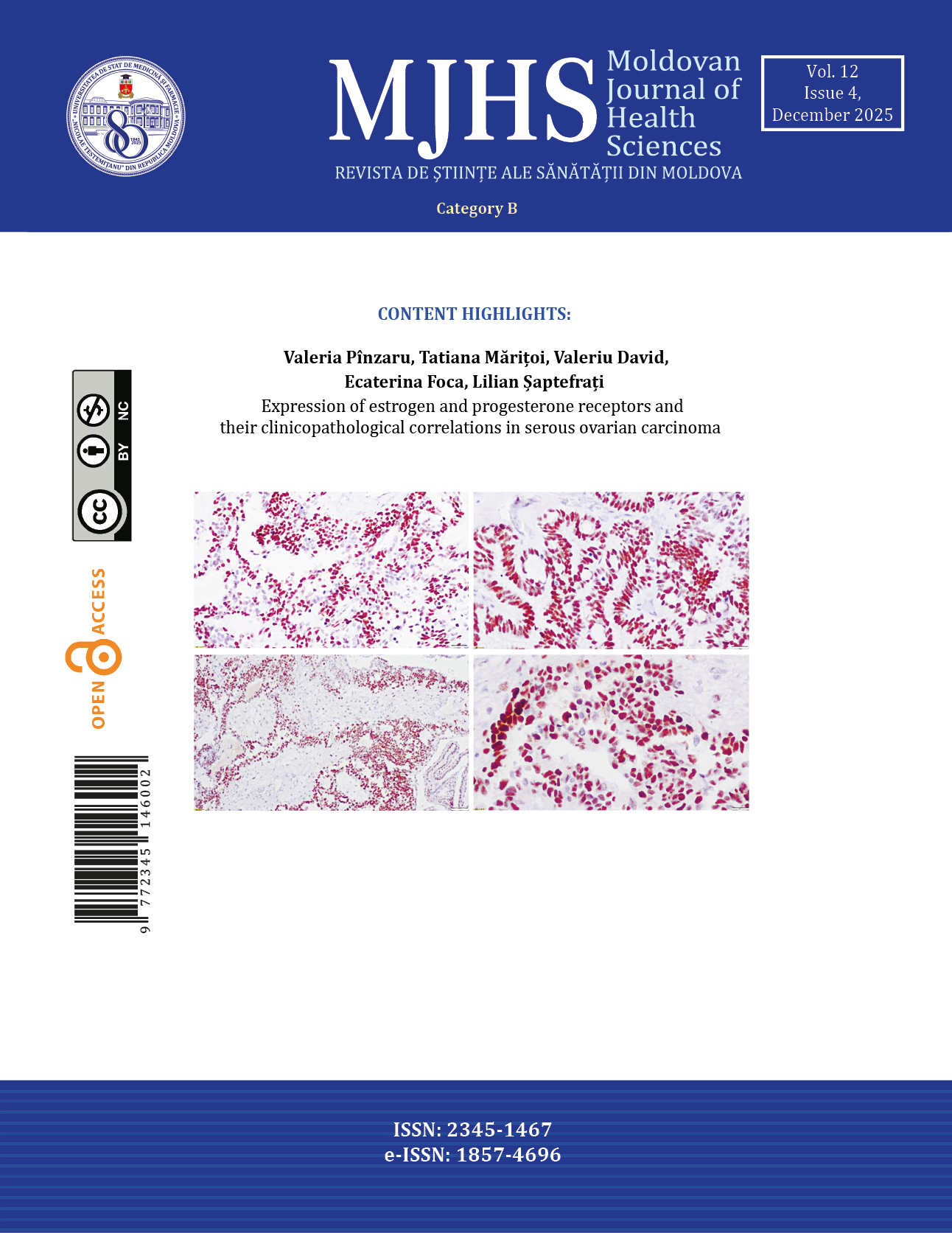
Expression of estrogen and progesterone receptors and their clinicopathological correlations in serous ovarian carcinoma

Valeria Pînzaru1,2*, Tatiana Mărițoi1,3, Valeriu David1,4, Ecaterina Foca4, Lilian Șaptefrați1,4
https://doi.org/10.52645/MJHS.2025.4.01

Introduction

Ovarian cancer continues to be the most lethal gynecologic malignancy, with high-grade serous ovarian carcinoma representing the most common and aggressive histological subtype. Although estrogen receptor and progesterone receptor have established prognostic and therapeutic relevance in other hormone-dependent cancers, such as breast carcinoma, their role in high-grade serous ovarian carcinoma remains insufficiently characterized and requires further elucidation.

Materials and methods

 A retrospective study was conducted on 40 cases of high-grade serous ovarian carcinoma diagnosed between 2022 and 2024 at two medical institutions in Chișinău, Republic of Moldova. Estrogen receptor and progesterone receptor expression was evaluated by immunohistochemistry, employing the Allred scoring system (range: 0–8). Clinical and pathological data were collected, including patient age, menopausal status, tumor grade, FIGO stage, CA-125 serum levels, and tumor laterality. Statistical analysis comprised descriptive statistics, Student’s t-test, Kruskal-Wallis test, Spearman’s rank correlation, Mann-Whitney U test, and Chi-square test. A p-value < 0.05 was considered statistically significant.

Results

Estrogen receptor positivity was detected in 60% of cases (Allred scores 4-8), exhibiting a diffuse nuclear staining pattern, whereas progesterone receptor positivity was observed in 50% of cases (scores 2–6) with focal or mosaic staining. Four immunoprofiles were identified: ER+/PR+ (35%), ER+/PR− (25%), ER−/PR+ (15%), and ER−/PR− (25%). A significant positive correlation was found between ER and PR expression (ρ = 0.472, p = 0.001). Elevated CA-125 levels were significantly associated with advanced FIGO stage (H = 15.52, p = 0.0014), higher tumor grade (H = 4.15, p = 0.041), and PR negativity. Bilateral ovarian involvement showed a strong correlation with advanced disease (ρ = 0.658, p < 0.00001). The ER−/PR+ immunoprofile was predominantly associated with the most advanced FIGO stages. No significant differences in estrogen receptor or progesterone receptor expression were observed between premenopausal and postmenopausal patients.

Conclusions

Hormone receptor expression in high-grade serous ovarian carcinoma exhibits significant associations with key clinicopathological parameters, including CA-125 levels, tumor grade, FIGO stage, and tumor laterality. Notably, loss of progesterone receptor expression correlates with more aggressive tumor behavior. Hormonal receptor profiling using the Allred scoring system may provide valuable insights for prognostic stratification and aid in therapeutic decision-making in serous ovarian carcinoma. Further investigations involving larger patient cohorts and comprehensive molecular characterization are warranted to validate and expand upon these findings.
View Article

Chromosomal variations in infertile men diagnosed by cytogenetic analysis

Stela Racoviță1,2 Veaceslav Moșin3, Svetlana Capcelea1, Ana Mișina4, Vasile Racoviță5, Elena Chesov1,2, Mariana Sprincean1,6
https://doi.org/10.52645/MJHS.2025.4.02

Introduction

Male infertility has a heterogeneous etiology, most commonly caused by disorders of spermatogenesis, clinically manifested as azoospermia or severe oligospermia. Genetic factors account for approximately 30% of male infertility cases associated with azoospermia. This high frequency is due to the involvement of numerous genes in the regulation of sexual development and reproduction. Among the various genetic causes of spermatogenic failure, chromosomal abnormalities are among the most clinically significant. The objective of the study was to evaluate the profile of chromosomal variations in infertile men with azoospermia, to optimize assisted reproductive strategies in infertile couples.

Material and methods

A group of 96 azoospermic men underwent karyotype analysis. The diagnosis of azoospermia was established based on at least two consecutive semen analyses performed according to the guidelines of the World Health Organization (WHO). Cytogenetic analysis was carried out on peripheral blood lymphocytes, with results interpreted according to the 2016 International System for Human Cytogenetic Nomenclature (ISCN). Hormonal profiles (FSH, LH, prolactin, testosterone) were correlated with chromosomal findings. Statistical analysis was performed using SPSS (Statistical Package for the Social Sciences), version 22.0.

Results

Cytogenetic investigations in azoospermic patients (n = 96) revealed karyotype variations in 25.0% of cases, including sex chromosome abnormalities in 16.7%: 47,XXY – Klinefelter syndrome (11.5%); microscopic structural variations of the Y chromosome (2.1%); and single cases of 47,XYY – Jacobs syndrome; 46,XX male – sex reversal; and 45,X/46,XY – mixed gonadal dysgenesis. Autosomal abnormalities were found in 8.3% of cases: translocations (3.1%), inversions (2.1%), chromosomal polymorphisms (2.1%), and one case with 46,XY,fra(17)(p12). Patients with sex chromosome abnormalities exhibited significantly higher FSH and LH levels compared to those with autosomal abnormalities (p < 0.05), whereas prolactin and testosterone levels did not differ significantly between the groups.

Conclusions

The high prevalence of chromosomal abnormalities in azoospermic men supports the inclusion of cytogenetic testing in the routine evaluation of male infertility. Identifying the type of chromosomal defect allows for appropriate genetic counseling and aids in decision-making regarding assisted reproductive options.

View Article

Electrocardiographic changes in patients with acute pulmonary embolism

Doina Ranga*, Cornelia Talmaci, Sergiu Matcovschi, Natalia Caproș
https://doi.org/10.52645/MJHS.2025.4.03

Introduction

Pulmonary embolism is a life-threatening condition requiring prompt diagnosis. While contrast-enhanced computed tomography is the gold standard, its limited availability and associated risks necessitate complementary diagnostic tools. Recent studies suggest that combining multiple electrocardiographic abnormalities into a composite score may enhance diagnostic performance.

Material and methods

We conducted a prospective, cross-sectional study involving 200 patients with suspected pulmonary embolism admitted to two hospitals in the Republic of Moldova between 2022 and 2025. Among them, 168 had confirmed pulmonary embolism based on computed tomography pulmonary angiography, while 32 patients with similar symptoms but negative imaging served as the control group. All participants underwent a standard 12-lead electrocardiogram upon admission. A composite electrocardiographic score was applied, incorporating 10 criteria (e.g., sinus tachycardia, S1Q3T3 pattern, negative T waves in V1-V4, right bundle branch block, and right axis deviation), with a total score ranging from 0 to 12. Diagnostic thresholds were defined as follows: 0-3 low risk, 4-6 intermediate risk, and ≥7 high risk.

Results

Electrocardiographic abnormalities such as negative T waves in V1–V4 (42.9% vs. 6.2%), atrial fibrillation (28.0% vs. 6.2%), and S1Q3T3 pattern (21.4% vs. 3.1%) were significantly more frequent in pulmonary embolism patients. A composite electrocardiographic score of ≥5 demonstrated excellent diagnostic performance: sensitivity 89.9%, specificity 93.8%, positive predictive value 98.7%, and overall accuracy 90.5%. The area under the ROC curve was 0.92, indicating strong discriminative ability. Among combinations of electrocardiographic findings, the pairing of S1Q3T3 with negative T waves in V1-V4 showed a statistically significant association with confirmed pulmonary embolism.

Conclusions

Our study confirms that a composite electrocardiographic score ≥5 is a highly effective, rapid, and noninvasive tool for identifying pulmonary embolism, improving early triage, particularly in emergency settings where imaging may be delayed. The model significantly outperforms isolated electrocardiographic findings and should be interpreted within a broader clinical context, including symptomatology and imaging when available.

View Article

Optimizing surgical management of thyroid nodules: a prospective study on an individualized approach

Alin Bour, Cristina Cojocaru
https://doi.org/10.52645/MJHS.2025.4.04

Introduction

Thyroid nodules are a common condition in medical practice, and the correct selection of patients for surgical treatment is essential in their management. Thyroidectomy is indicated with predilection for nodules suspected of being malignant, with progressive growth or with compressive symptoms.

Materials and methods

The study included 89 patients diagnosed with unilateral or bilateral thyroid nodules who met the indications for surgical treatment. All patients underwent preoperative evaluation, including clinical examination, standard laboratory tests, thyroid ultrasonography, hormonal profiling, and fine-needle aspiration in cases with a high suspicion of malignancy.

Results

Out of the total number of patients, 2 (2.25%) patients had contraindications to surgery due to cardiac comorbidities associated with high anesthetic-surgical risk. Total thyroidectomy was performed in 41 patients (46.09%), hemithyroidectomy in 44 patients (49.41%), and combined surgeries in 2 cases (2.25%). Postoperative outcomes were favorable in all patients, with no complications registered during the follow-up period. Hormone replacement therapy was administered based on postoperative thyroid hormone levels. Patients who did not undergo surgery were followed up regularly.

Conclusions

The extent of thyroidectomy should be tailored to each patient based on the estimated risk of malignancy and the clinical-imaging features of nodules. Total thyroidectomy is recommended in cases with suspected malignancy or bilateral disease, whereas lobectomy may be sufficient for unilateral benign nodules or low malignancy risk.

View Article

Descriptive analysis of pediatric laryngeal papillomatosis in Republic of Moldova: epidemiological and clinical characteristics

Daniela Cernev*, Vasile Cabac
https://doi.org/10.52645/MJHS.2025.4.05

Introduction

Recurrent laryngeal papillomatosis is a rare but significant pediatric condition caused by human papillomavirus types 6 and 11. Characterized by the repeated growth of benign exophytic lesions in the respiratory tract, recurrent laryngeal papillomatosis poses a considerable burden due to its recurrent nature, frequent need for surgical intervention, and potential impact on respiratory function. This study aims to describe the epidemiological profile of pediatric recurrent laryngeal papillomatosis in the Republic of Moldova, identify high-risk groups, and explore the socioeconomic implications of the disease. 

Material and methods

A retrospective, descriptive observational study was conducted using national data from 198 pediatric patients diagnosed with recurrent laryngeal papillomatosis and treated at the Emilian Coțaga Pediatric Otorhinolaryngology Clinic between 1981 and 2013. Demographic, clinical, and epidemiological variables were analyzed, including age at onset, sex, incidence, prevalence, and geographic distribution. Statistical analysis included descriptive methods, correlation coefficients, and linear regression models. Data were processed using Microsoft Excel and Python, with significance set at p < 0.05, for the 95% confidence interval. 

Results

The average annual incidence was approximately 6 new cases, with a peak of 15 in certain years. The estimated prevalence reached 4.2 per 100 thousand children. Most patients were male, and the disease commonly manifested at ages 1 and 4. Correlation analysis revealed strong associations between age, sex, and disease onset, particularly in males. Linear regression confirmed the predictive value of demographic variables, though the model's robustness is limited by sample size. No progression into adulthood was observed, and seasonal or cyclical patterns were not evident. 

Conclusion

Pediatric recurrent laryngeal papillomatosis in the Republic of Moldova shows a male predominance and early age of onset, with a consistent but relatively low incidence rate. Demographic indicators may aid in identifying at-risk populations, while early diagnosis and multidisciplinary management are essential to prevent complications. Expanding human papillomavirus vaccination coverage remains a critical public health priority. The findings support the need for prospective, multicenter research integrating vaccination status and immunological biomarkers to enhance disease prevention and control strategies.

View Article

Prevalence and severity of depression, anxiety, and cognitive impairment in acute ischemic stroke patients: a cross-sectional study

Mihaela Belous1*, Radislav Cosulean1, Dorin Jelaga1,2, Igor Nastas1,2, Jana Chihai1,2, Madalina Bivol1, Larisa Boronin1,2, Andrei Esanu2, Alina Bologan2, Cornelia Adeola2
https://doi.org/10.52645/MJHS.2025.4.06

Introduction

Post-stroke depression (PSD) and anxiety are common neuropsychiatric sequelae of stroke, occurring in roughly one-third of survivors. Cognitive impairment is also frequently observed, affecting up to half of stroke patients. These conditions adversely impact rehabilitation and quality of life. This study aimed to determine the prevalence and severity of depression, anxiety, and cognitive deficits in patients with acute ischemic stroke. 

Material and methods

We conducted an observational study involving 99 patients with acute ischemic stroke, assessed within approximately two weeks of symptom onset, who were admitted to a tertiary care unit. Depression and anxiety were assessed using the Patient Health Questionnaire-9 (PHQ-9) and Generalized Anxiety Disorder-7 (GAD-7) scales, supplemented by the clinician-rated Hamilton Depression (HAM-D) and Anxiety (HAM-A) scales. Cognitive status was evaluated with the Mini-Mental State Examination (MMSE). Descriptive statistics (proportions, means ± SD) were used to summarize the prevalence and severity of each condition. 

Results

The cohort had a mean age of 64.8  ±  8.1 years and was 63.5% male. Vascular risk factors were prevalent, with 88% of patients having hypertension and 33% having diabetes. Based on patient-reported measures, 16% of patients exhibited moderate depressive symptoms (PHQ-9 ≥10), while 42% reported moderate to severe anxiety (GAD-7 ≥10). Clinician-administered assessments identified 35% of patients with moderate to severe depression (HAM-D ≥17) and 35% with clinically significant anxiety (HAM-A ≥18). The vast majority of patients (~92%) reported at least mild depressive symptoms, although only 0–1% met the criteria for severe depression.

Conclusions

Depression, anxiety, and cognitive deficits are highly prevalent in the acute phase of ischemic stroke, with approximately one in three patients experiencing clinically significant depression or anxiety and one in four exhibiting cognitive impairment. These findings underscore the importance of early neuropsychological assessment and intervention as part of acute stroke care to improve rehabilitation outcomes. 

View Article

The relationship between zinc levels and immunological biomarkers in oral fluid in children affected by dental caries

Svetlana Plamadeală1*, Olga Tagadiuc2, Aurelia Spinei1
https://doi.org/10.52645/MJHS.2025.4.07

Introduction

Dental caries is one of the most widespread diseases in the human population, and the causes of increased susceptibility to dental caries remain of continuing interest to researchers. Active immunological components of oral fluid significantly influence the evolution of dental caries. The aim of this research is to study the relationship between zinc levels, the antimicrobial peptide LL-37, and transforming growth factor beta-1 in oral fluid, and the incidence of dental caries in children. 

Material and methods

In this observational cohort study, 398 children aged between 3 and 15 years were clinically examined. The research group included 132 children with dental caries, and the control group consisted of 266 caries-free children. The Plaque Index (PI) and caries experience indices were evaluated. Caries risk was assessed using the Cariogram software. The levels of zinc, the antimicrobial peptide LL-37, and transforming growth factor beta-1 in oral fluid were determined using standard EliTeh kits, in accordance with the manufacturer’s recommendations. The study was conducted in compliance with ethical standards and with written informed consent obtained from the children's parents. Data were processed automatically using the open-source software RStudio, version 2024.09.1+394. 

Results

In children from the research group, a significant decrease in the levels of zinc, the antimicrobial peptide LL-37, and transforming growth factor beta-1 was detected in oral fluid, showing an inverse relationship with caries morbidity indicators.

Conclusions

Significantly decreased levels of zinc, the antimicrobial peptide LL-37 and transforming growth factor beta-1 in oral fluid of caries-susceptible children may indicate an increased risk of caries. Low levels of zinc, the antimicrobial peptide LL-37, and transforming growth factor beta-1 in oral fluid may also serve as indicators of rapid progression of dental caries – a fact that should be taken into account when planning individualized preventive measures.

View Article

A simple method for preparing herbal reference standards based on salting-out solvent extraction

Igor Casian*, Ana Casian
https://doi.org/10.52645/MJHS.2025.4.08

Introduction

The expansion of the range of herbal medicinal products requires the availability of a large number of different reference standards for their analysis. A possible solution is the use of herbal reference standards (HRS), which, in turn, requires the development of simple production methods that meet all the requirements for reference standards.

Material and methods

Using ten plant species containing polyphenolic compounds, a general scheme for preparing HRS was developed and tested, which includes extraction of plant material with low concentrations of a polar organic solvent (usually 20% isopropanol), subsequent salting-out of the organic phase with ammonium sulfate, and drying the organic extract on the surface of anhydrous lactose. The composition of the obtained HRS and intermediates was determined by high-performance liquid chromatography using primary chemical reference standards.

Results

For all studied plant species, satisfactory values of the yield of target components, good solubility of the prepared HRS, and similarity of the chromatographic profiles of HRS and the corresponding plant material were obtained.

Conclusions

A simple and inexpensive method for preparing HRS, based on salting-out solvent extraction of target components, is proposed.

View Article

Toxico-hygienic and economic aspects of acute non-occupational chemical poisonings in the Republic of Moldova during the period 2019-2023

Tatiana Tonu1*, Iurie Pînzaru2, Ludmila Goma3, Natalia Daniliuc4
https://doi.org/10.52645/MJHS.2025.4.09

Introduction

Acute non-occupational chemical poisoning is a current public health problem in the Republic of Moldova, affecting both children and adults. The global increase in the use of chemical substances and mixtures raises the risk of chemical poisoning, which ranks fourth among the causes of injury in children, after road traffic injuries, burns, and drowning. It also generates a significant economic burden, and its quantification contributes to making informed decisions regarding the efficient allocation of resources.

Material and methods

A descriptive, retrospective, cross-sectional study was conducted based on statistical data from the statistical form f.18-săn and other national reports for the period 2019-2023. Cases of chemical poisoning were analyzed, excluding other types of poisoning. The evaluated indicators included incidence, mortality, distribution by age group and etiology, as well as the direct costs of their treatment.

Results

The analysis of statistical data revealed a total of 9,579 intoxications, with an overall incidence of 69.5 cases per 100,000 inhabitants. The most common causes were medications, which accounted for 41.8% (n = 4,002), followed by alcohol – 18.8% (n = 1,798), toxic gases – 14.5% (1,385 cases), and pesticides – 4.4% (n = 417). During the 2019-2023 period, children had a higher incidence, with 130.58 cases per 100,000 children, while adults recorded 52.21 cases. The peak incidence of chemical poisonings was recorded in 2019, at 64.8 cases per 100,000 population (24%, 95% CI: 23.12–24.83), while the lowest was in 2020, at 56.5 cases per 100,000 population (15.6%, 95% CI: 14.88–16.34). Over the five-year period, treatment costs for chemical poisoning totaled 58 million lei, highlighting the burden on the health system. 

Conclusions

Acute non-occupational chemical poisonings continue to be a significant public health problem in the Republic of Moldova, generating not only an impact on the morbidity and mortality of the population but also a considerable economic burden on the health system, highlighted by treatment expenses that amounted to over 57 million lei during the 2019-2023 period. Preventive, educational, and informational measures for the population, including awareness campaigns, are essential for reducing the number of acute poisonings of chemical etiology

View Article

Contemporary approach to pediatric ovarian tumors

Corina Iliadi-Tulbure*, Catalin Caus, Bogdan Marandiuc, Olga Cernetchi
https://doi.org/10.52645/MJHS.2025.4.12

Introduction

Pediatric ovarian tumors represent a rare but clinically important category of gynecologic conditions, comprising approximately 1-2% of all childhood malignancies and about 5% of pediatric abdominal masses. While most are benign, a meaningful percentage can be hormonally active, raising diagnostic and therapeutic challenges. Due to nonspecific symptoms such as abdominal pain or distension, early diagnosis is often delayed, potentially compromising fertility preservation and long-term outcomes. A multidisciplinary, age-specific approach is essential to optimize management.

Material and methods

This study is a narrative literature review based on an extensive search across PubMed, ScienceDirect, SpringerLink, and Google Scholar. The search covered the period from 2008 to 2025 and included terms such as "pediatric ovarian tumors", "germ cell tumors", "sex cord-stromal tumors", "diagnostic imaging", and "fertility preservation". Inclusion criteria encompassed peer-reviewed, full-text articles in English focusing on patients aged 0-19 years. A total of 20 sources, including clinical guidelines and articles, were selected for their thematic relevance and quality of evidence.

Results

Pediatric ovarian tumors show wide clinical and histological variability, with germ cell tumors being the most prevalent malignant subtype. Transabdominal ultrasound is the first-line imaging tool, while Magnetic Resonance Imaging is reserved for complex or inconclusive cases. Tumor markers, such as alpha-fetoprotein, beta-human chorionic gonadotropin, lactate dehydrogenase, and Inhibin B, are essential in differentiating tumor types and guiding management. Surgical decisions prioritize minimally invasive, fertility-sparing approaches when malignancy is unlikely. Long-term follow-up includes hormonal, reproductive, and psychosocial monitoring. Psychological support is particularly important for adolescents. Despite advancements, diagnostic delays, lack of pediatric-specific guidelines, and disparities in care, especially in low-resource settings, remain critical challenges.

Conclusions

Pediatric ovarian tumors require an individualized, multidisciplinary management strategy that integrates early detection, age-appropriate surgical care, fertility preservation, and long-term endocrine and psychological support. This review highlights the need for pediatric-specific protocols and improved access to diagnostics to enhance outcomes and preserve the future reproductive potential of affected children and adolescents.

View Article

Review

Current concepts in the management of bone lesions in multiple myeloma

Introduction

Bone lesions remain a serious, unresolved issue in patients with multiple myeloma. The management of myeloma-related bone disease involves a multimodal approach, including chemotherapy, bone antiresorptive agents (bisphosphonates), radiotherapy, pharmacological pain management, minimally invasive percutaneous orthopedic procedures, and invasive surgical interventions.

Material and methods

A bibliographic search was conducted using databases such as PubMed, Hinari, SpringerLink, the National Center for Biotechnology Information, and Medline. Articles published between 2000 and 2025 were selected using the following keywords: “bone lesions in multiple myeloma” in combination with terms such as “conservative treatment,” “surgical treatment,” “orthopedic surgery,” and “minimally invasive techniques” to maximize the search yield. Based on the established search criteria, a total of 286 full-text articles were identified. The final bibliography includes 42 relevant sources, deemed representative of the literature published on the topic of this review article.

Results

Bisphosphonates or denosumab should be considered the standard of care for the treatment of bone disease in patients with multiple myeloma. Cement augmentation (polymethylmethacrylate) is effective in managing painful vertebral compression fractures (percutaneous vertebroplasty, balloon-assisted percutaneous kyphoplasty). Radiotherapy is recommended for uncontrolled pain in cases of spinal cord compression or pathological fractures of long bones, especially in patients who show no response or minimal response to systemic treatment for multiple myeloma. Surgery should be used to prevent and repair pathological fractures of long bones, spinal instability, and spinal cord compression caused by bony fragments. Postoperative radiotherapy should be considered, particularly for long bone fractures, to achieve local disease control and prevent implant failure.

Conclusions

The current concept in the management of patients with multiple myeloma and bone lesions is based on developing an individualized approach that takes into account anatomical, biological, radiological, and social factors. The selection of surgical techniques must be tailored to each patient, based on general medical condition, quality of life and life expectancy, prior response to chemotherapy, fracture location, number, size and distribution of bone lesions, extent of bone invasion, neurological status, and patient expectations.

View Article

Stigmatization in medicine: impact on patients, healthcare providers, and ethical standards of care

nga Anisei-Cojocaru*, Liliana Rogozea
https://doi.org/10.52645/MJHS.2025.4.11

Introduction

Stigmatization is a social phenomenon that adversely affects not only access to care but also the quality of medical services. In the medical context, stigma occurs when patients – or even healthcare professionals – are treated differently, with prejudice or a lack of empathy, due to certain traits, conditions, or social affiliations.

Material and methods

We conducted a narrative review of stigma in healthcare settings. Searches were performed in PubMed/MEDLINE and Google Scholar, and complemented by consulting official public-health websites (WHO, ECDC, UNAIDS, Romanian MoH/NIPH) for the period 1 Jan 2000 – 27 Jul 2025 (English/Romanian). Search strategies combined terms related to stigma/discrimination, healthcare/quality of care, and vulnerable groups, with backward- and forward-citation tracking. Two reviewers screened against predefined criteria (peer-reviewed studies, reviews, authoritative institutional reports). Opinion pieces, non-healthcare contexts, duplicates, and inaccessible full texts were excluded, and evidence was synthesized qualitatively.

Results

Stigma in healthcare appears as discriminatory behavior that fosters exclusion, leading to delayed diagnoses, treatment abandonment, and loss of trust in the system. Vulnerable groups – such as people living with HIV/AIDS, those with mental disorders, LGBTQ+ individuals, substance users, the homeless, and ethnic minorities – are most affected. HIV-positive patients often face avoidance, while those with psychiatric conditions may be seen as “unpredictable” or dangerous. Such attitudes harm patients’ health, deepen inequities, and erode the core ethics of equity and respect. Stigma undermines the patient–provider relationship, discouraging preventive care and adherence to treatment, and can cause complete disengagement. For providers, stigma fosters “dehumanization,” unconscious bias, and skewed clinical decisions, leading to substandard care. Healthcare workers experiencing their own health issues may internalize stigma, avoid seeking help, and compromise the care they deliver.

Conclusions

Health-related stigma is widespread and takes multiple forms, profoundly degrading the quality of medical care and hindering patients’ access to services. Medical stigma generates serious systemic consequences: patients delay seeking treatment, avoid interacting with the health system, suffer emotional distress and burnout, and face extreme difficulty with social reintegration. These realities underscore the need for strategic interventions in professional education, legislation, and public awareness to combat stigma in healthcare.

View Article

β-adrenergic agonists and β-antagonists in sport performance: a narrative synthesis of pharmacological effects and anti-doping implications

Tatiana Chiriac1*, Ina Pogonea1, Tatiana Timercan2, Artiom Jucov 3,4, Silvia Stratulat2, Alisa Tăbîrță5, Victoria Chihai5
https://doi.org/10.52645/MJHS.2025.4.13

Introduction

In the context of increasingly intense athletic competition, athletes are motivated to enhance their performance through various methods, including the use of pharmacological substances that act on the adrenergic system. Among these, β2-adrenergic agonists are employed for their metabolic effects and their role in increasing endurance, whereas β-adrenergic antagonists are used in precision sports to reduce tremor and control anxiety. Both classes of substances present potential benefits as well as health risks, and are subject to strict regulations in high-performance sports.

Material and methods

A theoretical study was conducted based on the analysis of specialized scientific literature, aiming to evaluate the impact of β2-adrenergic agonists and β-adrenergic antagonists on athletic performance. Additionally, the current regulations of the World Anti-Doping Agency (WADA) were analyzed.

Results. β2-adrenergic agonists may contribute to the stimulation of muscle protein synthesis, enhancement of energy metabolism, and delay in the onset of fatigue. However, their use is associated with significant cardiovascular and metabolic side effects. β-adrenergic antagonists are effective in reducing tremor and sympathetic activation in precision sports but may decrease overall exercise capacity and induce bradycardia or chronic fatigue. Improper use of these substances can lead to severe sanctions in the context of athletic competitions.

Conclusions

Although β2-adrenergic agonists and β-adrenergic antagonists may offer certain advantages depending on the specific nature of the sport, their use must be strictly medically regulated and comply with anti-doping standards. Careful evaluation of the risk-benefit ratio is essential for safeguarding athletes’ health and preserving the integrity of competition.

View Article

Digital planning in orthodontics. Applicability of the Kau, Pan, Gallerano index in contemporary orthodontics

Valentina Trifan*, Ana Bolgari, Iana Baiceva, Daniela Trifan, Irina Zumbreanu
https://doi.org/10.52645/MJHS.2025.4.14

Introduction

Digital planning in modern orthodontics is crucial in contemporary era, as it allows dentists to expand the limits of patients’ diagnosis and clinical treatment. Using tools such as 3D scanners, cone beam computed tomography with various software gives clinicians the opportunity to achieve more precise diagnoses and accurate predictions of treatments. In this way, digital imaging offers a precise localization of impacted canines which allows for the integration and applications of the Kau, Pan, Gallerano index. 

Material and methods

To assess the applicability of the Kau, Pan, Gallerano index and digital planning in orthodontics, this review evaluates key studies that explore various aspects of the topic. Scientific databases such as Cochrane Library, Medline, Scopus, Medicus, NCBI, PubMed, and Google Scholar were used to find the necessary articles. Research methods like analysis, synthesis, systematization and description were applied. 

Results

After analyzing the available data, this review presents the benefits and opportunities of digital orthodontics. The findings demonstrate that the Kau, Pan, Gallerano index offers high diagnostic accuracy by effectively categorizing various types of impactions. Moreover, the analysis reveals a strong correlation between the Kau, Pan, Gallerano index scores and successful treatment outcomes, showing that the index with digital technologies improves diagnostic accuracy and treatment planning.

Conclusions

The reviewed literature collectively indicates that this index is a valuable tool in contemporary digital orthodontics. Its interdisciplinary connection with digital planning which provides strong predictive value, and its comprehensive assessment approach make it an important component in modern orthodontic practice. Future research should continue to explore the advantages and disadvantages of modern technologies used in orthodontic diagnosis and treatment planning, thus validating their efficiency and their applicability across diverse complex orthodontic cases.

View Article

Case study

Refractive lens exchange in a patient with high myopia and myopic astigmatism: a clinical case report

Serghei Porada1,2*, Iulia Tanurcova1,2, Ala Paduca1,3
https://doi.org/10.52645/MJHS.2025.4.15

Introduction

Refractive lens exchange is increasingly utilized for visual rehabilitation in patients with high myopia unsuitable for corneal refractive procedures. While effective, refractive lens exchange with intraocular lens implantation significantly improves visual acuity in young patients with high myopia and astigmatism, while maintaining a low risk of postoperative retinal complications, provided that thorough preoperative vitreoretinal assessment is conducted. However, it carries potential risks, notably retinal complications.

Case presentation

We present a case involving a 45-year-old female with high axial myopia and myopic astigmatism who underwent bilateral refractive lens exchange with the implantation of monofocal intraocular lenses. Comprehensive preoperative assessments included optical biometry, tonometry, fundus examination, and visual acuity measurements. Postoperative recovery was uneventful in the right eye. However, the patient developed a retinal detachment in the left eye approximately one year post-surgery. This complication was successfully managed with pars plana vitrectomy, endolaser photocoagulation, and silicone oil tamponade, resulting in an improvement of visual acuity to 0.3.

Conclusions

Refractive lens exchange can be an effective intervention for patients with high axial myopia but carries a risk of retinal detachment. Thorough preoperative evaluation, meticulous surgical technique, and patient counseling are essential. Prompt detection and management of complications like retinal detachment are crucial for preserving visual outcomes.

View Article