
Introduction
Neurodegenerative and mental disorders, such as Parkinson’s disease and major depressive disorder, present a considerable health issue, affecting hundreds of millions globally [1]. Monoamine oxidase (MAO) inhibitors remain important therapeutic agents in the treatment of these diseases [2]. The development of new drugs with improved safety and stability characteristics is thus of notable pharmaceutical interest. At the Organic Synthesis Laboratory, Institute of Chemistry, Moldova State University, a newly synthesized compound Dioxoindolinone (1-(2-oxo-propyl)-spiro[[1,3]dioxolane-2,3'-indolin]-2'-one) was obtained [3]. The substance has demonstrated significant pharmacological potential as an MAO inhibitor [4]. Therefore, establishing its stability profile represents a critical step for further pharmaceutical development and rational dosage form design.
In addition to efficacy, purity, and safety, stability is an important factor in ensuring the quality of a drug [5].
The quality, therapeutic efficacy and safety of the drug during storage directly depend on its ability to maintain its properties within the limits established by regulatory/normative documentation over a certain period of time under appropriate storage and transportation conditions, i.e., stability. Based on the results of the stability study, the shelf life is determined, the materials used for primary and secondary packaging and its type are selected, and the storage conditions of the drug are determined, which are indicated in regulatory/normative documents [6]. The main method for establishing and confirming the shelf life is considered to be real-time testing, which is carried out under conditions as close as possible to the expected storage conditions of commercial products. To determine the stability of new drug substances, forced degradation methods are usually applied. The main objective of these studies is to find out some fundamental properties of the substances, such as the nature and direction of degradation reactions, the identification (based on the data obtained) of the most important degraded products and the selection of the most appropriate analytical techniques to determine the active substance and its degradation products in the presence of each other. At the same time, the results of these tests can highlight how not only the substances but also, sometimes, the pharmaceutical forms, can cope with short-term, but extremely critical conditions, such as those during transportation [7-9].
However, data concerning the stability and degradation behavior of newly synthesized Dioxoindolinone are presently missing. The absence of such information constrains further pharmaceutical development and formulations studies.
The objective of the present study was to investigate the stability profile of Dioxoindolinone under stress conditions (acidic, alkaline, thermal, oxidative, humid and photolytic exposure) to identify possible degradation pathways and degradation products, and to formulate a stability-indicating analytical procedure appropriate for future quality monitoring of the substance.
Materials and methods
The study was conducted at the Drug Development Center within Nicolae Testemițanu State University of Medicine and Pharmacy. The stability evaluation of Dioxoindolinone was performed in accordance with ICH regulations and guidelines [10, 11].
For the stability studies under stress conditions, three experimental synthesis batches (01, 02, 03) of Dioxoindolinone, obtained at the Organic Synthesis Laboratory, Institute of Chemistry, Moldova State University, were used. An internal reference standard of 1-(2-oxo-propyl)-spiro[[1,3]dioxolane-2,3'-indolin]-2'-one-substance, purified by recrystallization with a purity of 99.98%, was also employed.
The following apparatus was used: analytical balance (OHAUS DV215 CD, Switzerland); spectrophotometer (Shimadzu UV-1800, Japan) and 10 mm quartz cuvettes; ultraviolet lamp chamber (UV with CN-6 filter, France) for exposure to 254 nm and 365 nm radiation; thermostat (TC-80M-2, Ukraine) set at 60 ± 1°C; ultrasonic bath (Sapfir, St. Petersburg). The following analytical grade reagents were used: 0.1 M hydrochloric acid (HCl) (ChemLab, Belgium); 0.1 M sodium hydroxide (NaOH) (ChemLab, Belgium); 3% hydrogen peroxide solution (H2O2) (CentroChem, Poland); ethanol (96%) (CentroChem, Poland).
To assess the stability of Dioxoindolinone, the spectrophotometric method, previously developed and validated [12], was used.
Preparation of the standard solution: 0.05 g Dioxoindolinone internal standard (exact mass) was dissolved in 20 ml of ethanol (96%) in an ultrasonic bath for 1 min and diluted to 50 ml with the same solvent in a volumetric flask. 1.5 ml of this solution was further diluted to 50 ml in a volumetric flask with the same solvent, and absorbance was measured at 257 ± 1 nm, using ethanol (96%) as the reference solution.
Preparation of the sample solution. 0.05 g of the Dioxoindolinone substance (exact mass) was dissolved in 20 ml of ethanol (96%) in an ultrasonic bath for 1 min and diluted to 50 ml with the same solvent in a volumetric flask (solution A).
The study of forced degradation.
The sample solution was subjected to oxidative degradation and hydrolysis in acidic and basic environments for 24 hours, with three UV-Vis spectrophotometric analyses: at 0, 3 and 24 hours. The absorbances of the test solutions were measured at 257 ± 1 nm, using ethanol (96%) as the reference solution. The concentration was calculated in relation to the absorbance of the standard solution.
Preparation of the sample solution for oxidative degradation (acid hydrolysis, basic hydrolysis). 1 ml of solution A was transferred into three stoppered test tubes, to which 1 ml of 3% hydrogen peroxide solution (1 ml 0.1 M hydrochloric acid; 1 ml 0.1 M sodium hydroxide) was added, respectively. From each test tube, 0.75 ml of the treated solution was diluted to 25 ml in a volumetric flask with ethanol (96%), and absorbance was measured at 257 ± 1 nm, using ethanol (96%) as the reference solution. The first test tube was analyzed immediately; the second test tube after 3 hours and the third one after 24 hours.
To test the stability to physical stress factors, the substance samples were exposed to high humidity (80% RH) by keeping them for 2 weeks in a desiccator above water. Other samples were exposed to ultraviolet radiation (in the UV chamber) for 48 hours and to high temperature (60 °C in the thermostat for 2 weeks). Subsequently, quantitative analysis was performed by the UV-Vis spectrophotometric method to evaluate the variations in the stability of Dioxoindolinone under the action of these stress factors [13].
Statistical analysis. Statistical analysis was performed using the Statistical Package for the Social Sciences (IBM SPSS Statistics) 10.5 software.
Results and discussion
To evaluate the degradation processes under stress, the assay variations of Dioxoindolinone were followed. For the assay, the absorption spectra of the standard solution and of the sample solutions were recorded before the application of the stress conditions (Fig. 1).
1 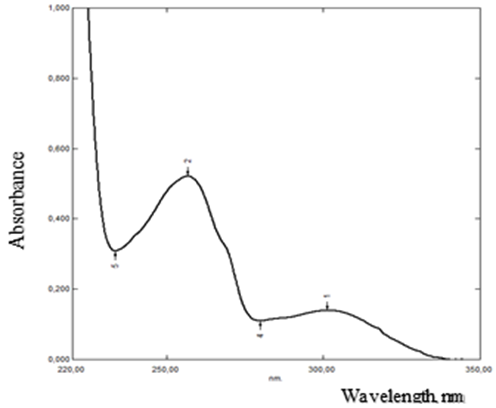 | 2 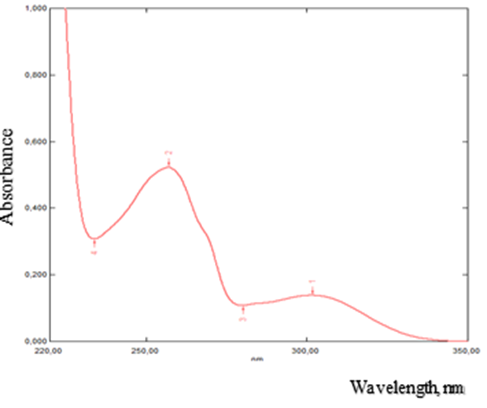 |
Fig. 1 Ultraviolet absorption spectra of Dioxoindolinone standard solution (1) and Dioxoindolinone sample (2) | |
The samples of the substance to be analyzed were subjected to oxidative stress (3% hydrogen peroxide solution), acidic hydrolytic stress (0.1 M hydrochloric acid) and basic hydrolytic stress (0.1 M sodium hydroxide); thermal (60 oC), photolytic (UV light), the substance was investigated under the influence of humidity. The evaluation of the degree of influence of stress factors on Dioxoindolinone was carried out at time intervals: 0 minutes, 3 hours and 24 hours following exposure to the above-mentioned factors (when investigating oxidative, acidic and basic stress); 24 hours and 48 hours (photolytic stress in the UV chamber) or at time intervals: 1 week and 2 weeks (when investigating the influence of humidity and thermal stress). All experiments were conducted in triplicate, and data were expressed as the mean.
Degradation under stress conditions
Oxidative stress
Oxidative degradation can be initiated by three factors: UV light, heat or physical strain in the presence of an oxygen-containing atmosphere, and may occur via two mechanisms: photo-oxidation and thermal oxidation. The selection of an oxidizing agent, its concentration and conditions depend on the drug substance, the most frequently used standard agent is hydrogen peroxide [9].
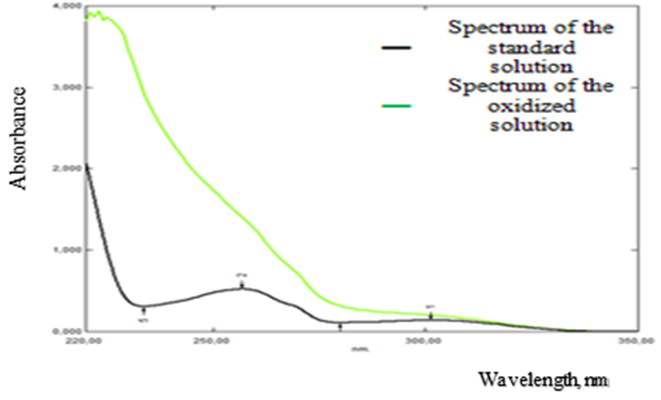
Under the action of the oxidant (3% hydrogen peroxide solution), complete degradation of Dioxoindolinone was observed, with a change in the absorption spectrum, which made it impossible to determine the absorbance and content (Fig. 2).
| ||||
Hydrolytic stress
Hydrolysis is one of the most prevalent chemical degradation reactions, which includes the splitting of a chemical compound by reaction with water. The ionizable functional groups present in the molecule are catalyzed during hydrolytic investigation in acidic and alkaline environment. Acid and base stress testing involve the forced degradation of drug substances by exposure to acidic and basic environments that produce primary degradants in the desired range. The choice of the type and strength of the acid or base depends on how stable the drug substance is. As suitable hydrolysis agents, hydrochloric acid or sulfuric acid for acid hydrolysis and sodium hydroxide or potassium hydroxide for alkaline hydrolysis are proposed [5, 6, 8, 14].
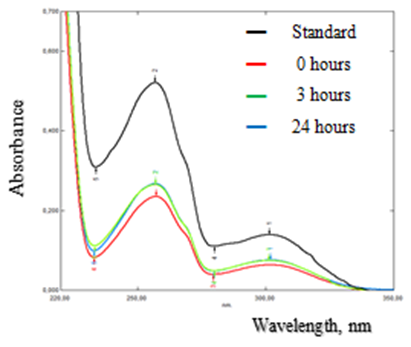
To highlight the influence of acids on Dioxoindolinone, 0.1 M hydrochloric acid was used, and for creation of the basic medium – 0.1 M sodium hydroxide. Absorption spectra of stressed solutions in acidic and basic media were recorded.
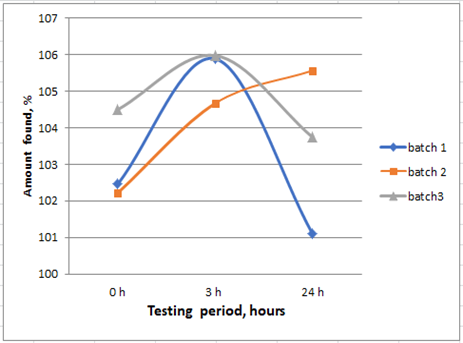
Acidic hydrolytic stress caused insignificant degradation of Dioxoindolinone, by 2.45% at 3 hours and 2.04% at 24 hours (Fig. 3).
| ||||
The results obtained from basic hydrolysis indicate degradation processes with the shift of the absorption maximum from 258 nm to 255 nm (0 min), to 250 nm (3 hours) and to 243 nm (24 hours), and the increase in measured concentration due to the formation of degradation products (0 min – 108.99%, 3 hours – 135.04%, 24 hours – 175.33%) (Fig. 4.).
1 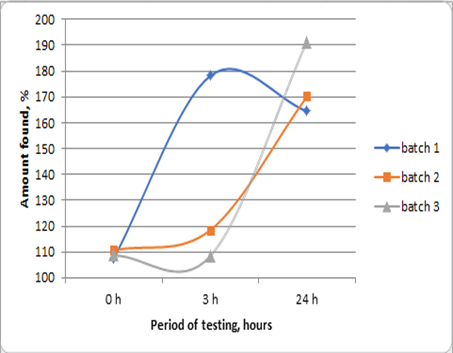 | 2 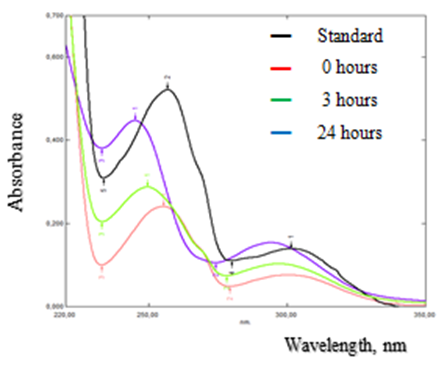 |
Fig. 4 Modification of the concentration of Dioxoindolinone following basic hydrolysis (1) and the absorption spectra of Dioxoindolinone under the action of basic hydrolytic stress (2) Note: The average results for three batches of substance are shown | |
Influence of humidity, photolytic, and thermal stress
Moisture, as an atmospheric factor, creates favorable conditions for oxidation processes, hydrolysis, as well as for microbial growth. At the same time, light and temperature represent activating factors of drug degradation reactions; an increase in temperature leads to an increase in the rate of the degradation reaction. Therefore, these factors must be studied in the process of analyzing of the substance [8, 9, 14, 15].
Dioxoindolinone exhibited a high degree of stability under humid conditions (in a desiccator above water for 2 weeks). The results obtained indicate that Dioxoindolinone is not hygroscopic and does not undergo degradation, the quantitative content being practically unchanged (0 min – 99.87%, 1 week – 99.51%, 2 weeks – 99.71%) (Fig. 5.).
1 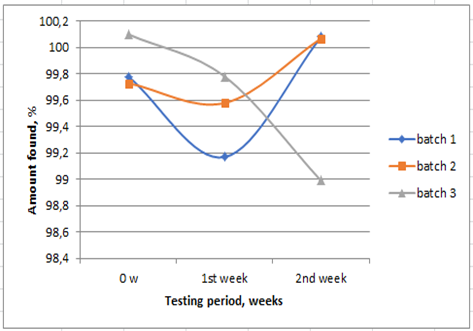 | 2 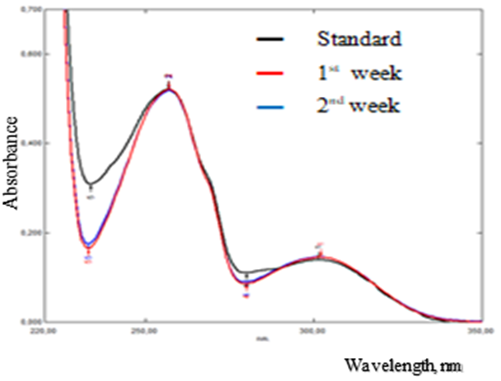 |
Fig. 5 Modification of the concentration of Dioxoindolinone following influence of humidity (1) and the absorption spectra of Dioxoindolinone under the influence of humidity (2)/ Note: The average results for three batches of substance are shown | |
Dioxoindolinone was evaluated over 0-48 hours of photolytic stress. The results of the determinations are shown in Figure 6. Upon interaction with ultraviolet radiation, a change in the content of Dioxoindolinone of 2.23% was observed (0 min – 99.87%, 24 hours – 99.21%, 48 hours – 102.1%).
1 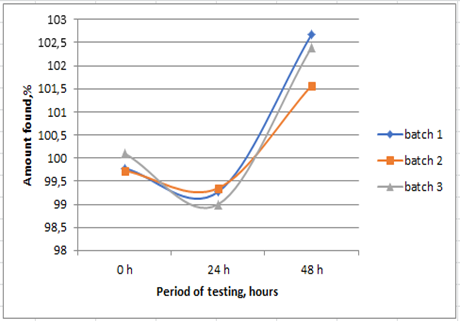 | 2 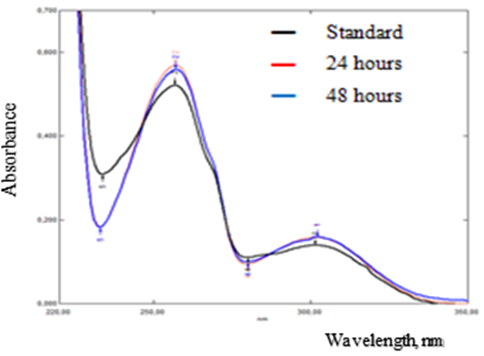 |
Fig. 6 Modification of the concentration of Dioxoindolinone following photolytic stress (1) and the absorption spectra of Dioxoindolinone under the action of photolytic stress (2) Note: The average results for three batches of substance are shown | |
The influence of high temperature on Dioxoindolinone was evaluated. The substance placed in an open container was stored at high temperature (60 0C) in the thermostat for 2 weeks.
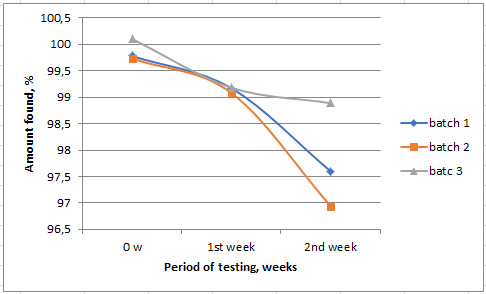
Samples subjected to thermal stress of 60 o C showed a change of 2.06% (0 min – 99.87%, 1 week – 99.14%, 2 weeks – 97.81%) (Fig. 7.).
1
| 2 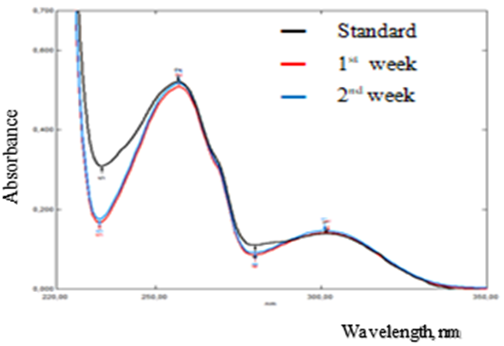 |
Fig. 7 Modification of the concentration of Dioxoindolinone following thermal stress (1) and the absorption spectra of Dioxoindolinone under the action of thermal stress (2) Note: The average results for three batches of substance are shown | |
The most important changes in the samples subjected to forced degradation occurred under the action of oxidants and in a basic environment. Under the influence of the oxidizing agent the substance degraded, which was demonstrated by the complete change in the absorption spectrum, which made it impossible to determine the content of Dioxoindolinone in the sample. In a basic environment, Dioxoindolinone decomposed, and the degradation products increased the absorbance, causing concentration oscillations. In an acidic environment, the substance was stable, with concentration varying within 2%.
The results of the thermal stability evaluation indicate that Dioxoindolinone is stable under thermal stress, with concentration within1.57%.
Although light is considered to be a destructive factor for medicinal substances, Dioxoindolinone demonstrated relative stability to UV irradiation, with a concentration increase of 2.9%.
The results of the evaluation of stability to humidity demonstrated that Dioxoindolinone is stable under high humidity, with no significant change in concentration observed.
The main quality parameter denoting the presence or absence of degradation processes in medicinal substances is Assay. In Table 1, the results of sample assay using the UV-Vis spectrophotometric method under various stress factors are presented.
Table 1. Modification of Dioxoindolinone concentrations under the action of stress factors | ||||||||
| Testing frequency | λmax, nm | Batch 1 | Batch 2 | Batch 3 | |||
Absorbance | Amount found, % | Absorbance | Amount found, % | Absorbance | Amount found, % | |||
H2O2 3 % | - | - | - | - | - | - | - | - |
0.1 M HCl | 0 hours | 251.1 | 0.299 | 102.46 | 0.323 | 102.22 | 0.235 | 102.34 |
3 hours | 256.6 | 0.309 | 105.89 | 0.298 | 104.67 | 0.265 | 104.50 | |
24 hours | 256.8 | 0.295 | 106.09 | 0.286 | 105.57 | 0.268 | 105.74 | |
0.1 M NaOH | 0 hours | 256.2 | 0.314 | 107.61 | 0.303 | 110.7 | 0.443 | 108.68 |
3 hours | 246.3 | 0.521 | 178.2 | 0.321 | 118.49 | 0.441 | 108.43 | |
24 hours | 241.6 | 0.480 | 164.49 | 0.461 | 170.16 | 0.781 | 191.36 | |
t = 60 °C
| 0 hours | 257 | 0.541 | 99.78 | 0.531 | 99.73 | 0.517 | 100.10 |
1 week | 257 | 0.502 | 99.17 | 0.504 | 99.08 | 0.503 | 99.18 | |
2 weeks | 257 | 0.504 | 97.6 | 0.507 | 96.94 | 0.516 | 98.89 | |
UV
| 0 hours | 257 | 0.541 | 99.78 | 0.530 | 99.73 | 0.517 | 100.10 |
24 hours | 257 | 0.570 | 99.27 | 0.554 | 99.35 | 0.570 | 99.00 | |
48 hours | 257 | 0.560 | 102.68 | 0.546 | 101.57 | 0.566 | 102.04 | |
Moisture | 0 hours | 257 | 0.540 | 99.78 | 0.531 | 99.73 | 0.517 | 100.10 |
1 week | 257 | 0.522 | 99.17 | 0.524 | 99.58 | 0.524 | 99.78 | |
2 weeks | 257 | 0.518 | 100.08 | 0.516 | 100.07 | 0.516 | 98.99 | |
Note:λmax – the wavelength corresponding to maximum absorbance, t - temperature, UV - Ultra-violet, H2O2 – peroxide of hydrogen; HCl – hydrochloric acid; NaOH – sodium hydroxide; The average results for three batches of substance are shown | ||||||||
Conclusions
Forced degradation is an analytical method used to test a drug under more extreme conditions than those encountered in accelerated stability studies.
Under conditions of oxidative, hydrolytic, thermal, acid-base, photolytic stress, the UV-Vis spectrophotometric method demonstrated that the substance is stable under humid conditions humidity and in an acidic environment. Dioxoindolinone was found to degrade under the influence of oxidant, it was unstable in basic environment (a change in concentration was observed). The insignificant influence of UV light and high temperature was demonstrated.
The results obtained will be confirmed by real-time stability studies. Currently, the substance is stored under normal conditions (25°C; 65% RH) for 4 years and 10 months. So far, the drug substance meets all the quality criteria stipulated in the draft specification.
Competing interests
None declared.
Acknowledgements and funding
This work was fulfilled with the financial support from the Project: Development of new pharmaceutical products from local raw materials (No. 080301), Nicolae Testemițanu State University of Medicine and Pharmacy.
Ethics approval
No approval was required for this study.
Provenance and peer review
Not commissioned, externally peer-reviewed.
Author’s ORCID ID
Tatiana Ștefaneț – https://orcid.org/0000-0003-2060-8382
References
Liu W, Zhang Y, Chen J, Li X, Huang Y, Zhao F, Chen F, Qu P and Li Y. Global burden and trends of major mental disorders in individuals under 24 years of age from 1990 to 2021, with projections to 2050: insights from the Global Burden of Disease Study 2021. Front Public Health. 2025;13:1635801. doi: 10.3389/fpubh.2025.1635801.
Kumar S, Nair AS, Abdelgawad MA, Mathew B. Exploration of the detailed structure–activity relationships of isatin and their isomers as monoamine oxidase inhibitors. ACS Omega. 2022;7(19):16244-16259. doi: 10.1021/acsomega.2c01470.
Macaev F, Stîngaci E, Sucman N, Bilan D, Gorincioi E, inventors. Synthesis procedure monotopic sequential synthesis of β-ethylene acetals of 1-(phenacyl-, acetonyl)isatins. Republic of Moldova Patent Application, Deposit no. a 2025 0008; 2025 Feb 11 (unpublished data).
Chiriță C, Marineci CD, Zbârcea CE, Mihai DP, Ștefaneț T, Valica V, Negreș S. Research action antidepressants of a new 2-indolinone derivative. In: Pharmacy: from innovation to good pharmaceutical practice: 18th National Pharmacy Congress of Romania; 2021 Sept 15-17; Oradea, Romania. Oradea; 2021. p.172.
Verma A, Singla S, Palia P. Development of forced degradation and stability indicating studies of drugs: a review. Asian J Pharm Res Dev. 2022;10(2):83-89. doi: 10.22270/ajprd.v10i2.1104.
Sakaeva IV, Buniatian ND, Kovaleva EL, Sakanian EI, Mit'kina LI, Prokopov IA, Shelekhina ES, Mit'kina IuV. [Basic approaches to drug stability studies: domestic and international experience]. [Regul Res Med Eval] (Moscow). 2013;(3):8-11. Russian [cited 2025 Dec 12]. Available from: https://cyberleninka.ru/article/n/osnovnye-podhody-k-izucheniyu-stabiln…
Enciu M, Chiurciu V, Oltean EG, Nica AG. Degradarea forțată a produsului Romprogestin 1% pentru validarea metodei HPLC și evaluarea stabilității medicamentului [Forced degradation of Romprogestin 1% for HPLC method validation and stability evaluation]. Vet Drug (Timisoara). 2018;12(1):64-71. [cited 2025 Dec 12]. Available from: https://www.veterinarypharmacon.com/docs/1951-2018_VD_12(1)_ART5.RO.pdf
Bajaj S, Singla D, Sakhuja N. Stability testing of pharmaceutical products. J Appl Pharm Sci. 2022;2 (3):129-138. [cited 2025 Dec 12]. Available from: https://japsonline.com/admin/php/uploads/409_pdf.pdf
Blessy M, Patel RD, Prajapati PN, Agrawal YK. Development of forced degradation and stability indicating studies of drugs: a review. J Pharm Anal. 2014;4(3):159-165. doi: 10.1016/j.jpha.2013.09.003.
International Council for Harmonization. ICH guideline Q1A(R2): Stability testing of new drug substances and products. Step 5: Note for guidance on stability testing: stability testing of new drug substances and products (CPMP/ICH/2736/99). London: EMA; 2003.
International Council for Harmonization. ICH guideline Q1B: Photostability testing of new drug substances and products. 1996. In: Proceedings of the International Conference on Harmonization; 2005.
Ștefaneț T, Valica V, Stîngaci E, Macaev F. Elaborarea și validarea metodei spectrofotometrice în ultraviolet și vizibil de dozare a dioxoindolinonei [Development and validation of a UV-Vis spectrophotometric method for Dioxoindolinone dosage]. Rev Farm Mold. 2024;53(Suppl):58-64. Romanian.
Ștefaneț T, Macaev F, Stîngaci E, Valica V. Investigation of the stability of Dioxoindolinone under stress conditions. In: The 37th Balkan Medical Week “The perspectives of Balkan medicine in the post COVID-19 era”, 2023 June 7-9, Chisinau, Republic of Moldiva: Abstract book. Bucharest; 2023. p. 281.
Nicolai E, Vislouh O, Valica V, Parii S, Uncu L. Stability studies of combined ear drops for the treatment of otitis. Mold Med J. 2020;63(3):43-50. doi: 10.5281/zenodo.3958557.
Glass BD, Novak C, Brown ME. The thermal and photostability of solid pharmaceuticals. J Therm Anal Calorim. 2004;77:1013-1036. https://doi.org/10.1023/B:JTAN.0000041677.48299.25