Published
13 September 2026
Articles
16
Pages
3–125
ISSN
2345-1467
e-ISSN
1857-4696
Access
Open · CC BY-NC 4.0
Editorial
Notes on this issue
Table of contents
16 papers · pp. 3–125Research9 papers
01
Predictors of community-acquired pneumonia severity in patients with chronic heart failure
Virginia Cascaval · Tatiana Dumitraș · Diana Fetco-Mereuta · Livi Grib · Sergiu Matcovschi · Cornelia Talmaci · Natalia Caproș · Elena Bivol
Introduction.
Community-acquired pneumonia (CAP) remains a major cause of morbidity and mortality, particularly in patients with chronic heart failure (CHF), who are at increased risk of adverse outcomes. Identifying reliable predictors of disease severity in this population is essential for timely risk stratification and optimization of therapeutic strategies.
Aim of the study.
Assessment of clinical and disease-course characteristics, oxidative stress, and predictors of CAP severity in patients with CHF.
Materials and methods.
A total of 210 patients were enrolled in the study and divided into two groups: group 1 (n = 105) – patients with community-acquired pneumonia associated with chronic heart failure and group 2 (n = 105) – patients with community-acquired pneumonia without chronic heart failure. The research was conducted based on clinical examination of patients, daily monitoring of the inflammatory process, assessment of comorbidities, and paraclinical investigations. Statistical analysis of the collected data was performed using a wide range of methods, including descriptive statistics, correlational analysis, and regression models.
Results.
The age of patients in the study group ranged from 50 to 92 years, with a mean of 70.6 ± 8.89 years (95% CI [68.8–72.3]), (F = 18.109; p = 0.205). In Group 1, the proportion of women was 57 (54.3%; 95% CI [44.8-64.1]), and that of men was 48 (45.7%; 95% CI [35.9-55.2]). In Group 2, the proportion of men was higher than that of women: 54 (51.4%; 95% CI [42.3-61.0]) men and 51 (48.6%; 95% CI [39.0-57.7]) women, respectively (χ2 = 0.686; df = 1; p = 0.407). Ischemia-modified albumin values were higher in patients in Group 1 compared to Group 2: 236.60 ± 57.23 µM/L and 229.77 ± 64.35 µM/L, respectively, (F = 0.660; p = 0.045). The IMA threshold value of 218.98 µM/L was determined for patients with CHF and severe CAP. The mean NT-proBNP values in Group 1 patients were 1371.88 ± 498.91 pg/ml, compared to Group 2: 58.19 ± 48.22 pg/ml, (F = 721.54; p < 0.0001). The NT-proBNP threshold value of 1665.73 pg/ml was identified for severe CAP in CHF patients. A method which allows early detection in 87.0% of cases of patients with CHF at high risk of severe community-acquired pneumonia was developed.
Conclusions.
Our hypothesis that community-acquired pneumonia in patients with chronic heart failure is more frequently associated with a severe clinical course was confirmed. The proposed NT-proBNP and ischemia-modified albumin threshold values, together with our risk estimation formula, may improve early therapeutic intervention to prevent severe complications.
02
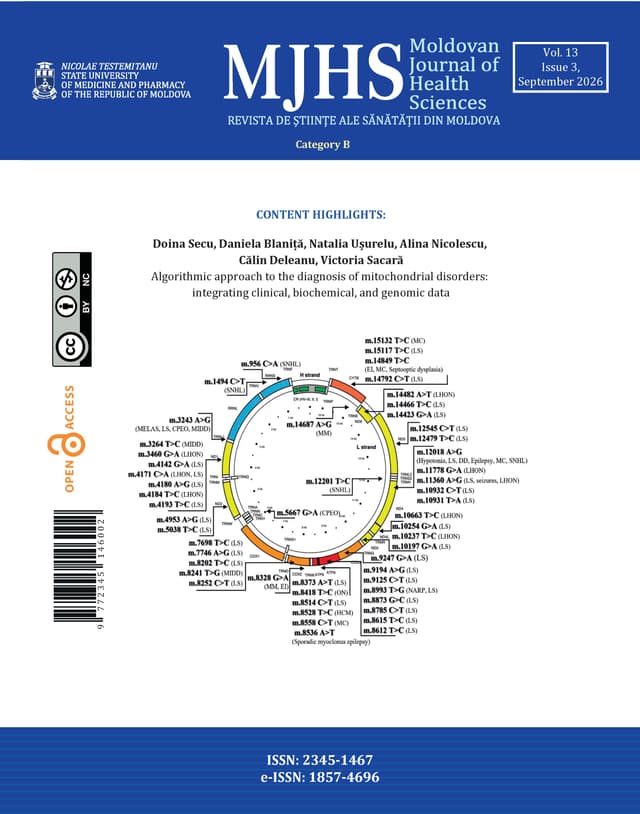
Algorithmic approach to the diagnosis of mitochondrial disorders: integrating clinical, biochemical, and genomic data
Doina Secu · Daniela Blăniță · Natalia Ușurelu · Alina Nicolescu · Călin Deleanu · Victoria Sacară
Introduction.
Mitochondrial diseases present heterogeneous clinical features that overlap with numerous genetic disorders, making early diagnostic stratification essential. This study aimed to evaluate the performance of a stepwise molecular diagnostic algorithm integrating High-Resolution Melting qPCR screening and targeted sequencing in individuals suspected of mitochondrial pathology based on a Nijmegen Mitochondrial Disease Score (NMDS) ≥3.
Materials and methods.
The analysis included 240 patients with clinical suspicion of mitochondrial disease and an NMDS ≥3, all evaluated through a standardized clinical, biochemical, and instrumental assessment. Molecular testing followed a tiered workflow: initial qPCR-HRM screening for seven common mtDNA mutations, followed by targeted Sanger sequencing of mitochondrial genes, including POLG hotspot regions, in patients meeting predefined clinical and NMDS thresholds. For individuals subsequently identified with non-mitochondrial etiologies, next-generation sequencing approaches were performed in accredited external laboratories. Statistical evaluation relied on descriptive statistical methods and non-parametric comparative analyses.
Results.
Molecular analysis confirmed mitochondrial involvement in 37 patients (15.4%) and identified non-mitochondrial genetic disorders in 44 patients (18.3%), while 159 individuals (66.3%) remained without a definitive molecular diagnosis. Patients with mitochondrial involvement showed higher frequencies of severe neuromuscular dysfunction, developmental regression, ophthalmic manifestations including ophthalmoplegia, and cardiovascular involvement. By contrast, neurodevelopmental and behavioral impairments and dysmorphic features were more prevalent in non-mitochondrial and undiagnosed patients. Biochemically, elevated plasma lactate and hyperalaninemia were significantly more common among individuals with mitochondrial involvement. Neuroimaging findings in this group were characterized by cerebral and cerebellar atrophy and basal ganglia abnormalities. Consistently, NMDS values were markedly higher in patients with mitochondrial involvement, and their integration as threshold-based decision points within the stepwise diagnostic algorithm substantially enhanced diagnostic stratification, enabling more precise differentiation between mitochondrial involvement and alternative genetic etiologies.
Conclusions.
The structured algorithm integrating NMDS-based selection, qPCR-HRM screening, and targeted sequencing demonstrated effective stratification of patients with suspected mitochondrial disease, achieving a combined diagnostic rate of 33.7%. These findings support the utility of this tiered approach in distinguishing mitochondrial from non-mitochondrial genetic conditions and in optimizing molecular diagnostic workflows.
03
Introduction.
Cardiogenic shock (CS) represents the most severe form of acute circulatory failure and is associated with
high mortality. The prognostic role of cardiac arrhythmias and acute pulmonary edema (APE), as well as the potential role
of advanced hemodynamic monitoring, remains incompletely understood.
Materials and methods.
This retrospective observational study included 105 medical records of patients with cardiogenic
shock admitted between June 2016 and August 2018 to the Holy Trinity Municipal Clinical Hospital, Chișinău. Patients were
divided into two groups according to the type of monitoring used during hospitalization: the PiCCO group (n = 52) and
the standard ECHO group (n = 53). Clinical characteristics, arrhythmia subtype, presence of APE, and in-hospital mortality
were recorded. Continuous variables were expressed as mean ± SD and compared using Student’s t-test, while categorical
variables were analyzed using the χ² test or Fisher’s exact test. Statistical significance was set at p < 0.05.
Results.
Arrhythmias were present in 92.4% of patients, and AF/AFL was the most frequent arrhythmia (56.2%). Mortality
did not significantly differ according to arrhythmia subtype (p > 0.05). APE was detected in 60.9% of patients and was associated
with markedly higher mortality (75.0%). In-hospital mortality was lower in the PiCCO group than in the ECHO group
(36.5% vs 62.3%, p = 0.0112), particularly among patients with arrhythmias and among those without cardiac arrest.
Conclusions.
The specific type of arrhythmia was not significantly associated with mortality in cardiogenic shock. APE
represents a major marker of hemodynamic severity and was associated with significantly increased mortality, particularly
in the presence of arrhythmias. Advanced hemodynamic monitoring using PiCCO was associated with lower observed mortality;
however, baseline differences between groups limit causal interpretation. Further prospective randomized studies
are warranted to validate these findings.
04
Elective versus emergency umbilical hernia repair in patients with decompensated cirrhosis: a retrospective cohort study
Sergiu Pisarenco · Gheorghe Anghelici · Tatiana Zugrav · Oleg Crudu · Gheorghe Lupu · Liviu Chiriac
Introduction.
Evidence on umbilical hernia repair in patients with decompensated cirrhosis, ascites, and Child–Pugh class C is limited. In this population, outcomes after emergency repair may reflect both the urgency of the presentation and the greater hepatic, renal, inflammatory, and metabolic derangement present at the time of surgery.
Materials and methods.
This retrospective single-center cohort study included all 40 eligible adults with decompensated cirrhosis, ascites, and Child–Pugh class C at admission who underwent open primary non-mesh umbilical hernia repair between January 2019 and December 2025. Twenty patients underwent elective repair, defined as definitive repair scheduled after a short period of inpatient optimization, and 20 underwent emergency repair after limited stabilization because an acute hernia-related indication made postponement unsafe. The primary outcome was all-cause 30-day mortality. Secondary outcomes were in-hospital mortality, acute kidney injury, sepsis, wound infection, persistent ascitic leakage, reoperation, length of hospital stay, and early postoperative clinical-biochemical status. Analyses were unadjusted and exploratory; no multivariable model was fitted.
Results.
At admission, the emergency group had higher total bilirubin, international normalized ratio, creatinine, leukocyte count, Child–Pugh score and MELD-Na score, and lower serum albumin and sodium (all p ≤ 0.006). During a median elective optimization interval of 4.5 (3.0–6.0) days, the MELD-Na score decreased by a median of 2 (1–3) points. On postoperative days 2–3, every reported clinical-biochemical indicator remained less favorable in the emergency group. Median hospital stay was 14.5 versus 11.0 days (p = 0.038). Thirty-day mortality was 35.0% versus 10.0% (risk difference 25.0%, 95% confidence interval −1.3 to 47.9; p = 0.127).
Conclusions.
Patients undergoing emergency repair reached surgery with substantially greater clinical and biochemical derangement, had a less favorable early postoperative profile and stayed longer in the hospital, while the mortality difference did not reach statistical significance. Because operative timing was determined by the clinical course, the groups were not comparable at baseline and no causal effect of urgency or of preoperative optimization can be inferred. The findings support early multidisciplinary assessment while an elective operative pathway remains feasible.
05
The role of intra-abdominal pressure in the evolution of ascitic syndrome complications in decompensated liver cirrhosis
Sergiu Pisarenco · Gheorghe Anghelici · Tatiana Zugrav · Oleg Crudu · Gheorghe Lupu · Liviu Chiriac
Introduction.
The clinical value of admission intra-abdominal pressure in patients with decompensated liver cirrhosis and refractory ascites remains insufficiently defined, particularly in relation to the different phenotypes of ascitic fluid infection.
Material and methods.
An exploratory observational analysis was performed on a structured dataset that included 100 patients with decompensated liver cirrhosis, refractory ascites, and a Child-Pugh class C score. All patients had the results of the diagnostic paracentesis performed at admission and the transvesical measurement of intra-abdominal pressure available. Ascitic fluid phenotypes were defined on the basis of the polymorphonuclear cell count and the ascitic culture result: spontaneous bacterial peritonitis, bacterascites, and sterile ascites. Intra-abdominal hypertension was defined as an intra-abdominal pressure ≥12 mmHg. The primary objective was the comparison of admission intra-abdominal pressure among phenotypes. The secondary objectives consisted of examining the associations between admission intra-abdominal pressure and acute kidney injury, sepsis, acute-on-chronic liver failure, and the need for intensive care.
Results.
The cohort included 22 patients with spontaneous bacterial peritonitis, 10 with bacterascites, and 68 with sterile ascites. Median admission intra-abdominal pressure differed significantly among phenotypes, being highest in spontaneous bacterial peritonitis and lower in bacterascites and sterile ascites: 16.9 (15.2–17.9), 13.4 (11.7–15.4), and 13.4 (12.1–14.6) mmHg, respectively (p<0.001). Intra-abdominal hypertension was present in all patients with spontaneous bacterial peritonitis, in 60.0% of those with bacterascites, and in 75.0% of those with sterile ascites. In adjusted logistic models, each 1-mmHg increase in admission intra-abdominal pressure was independently associated with spontaneous bacterial peritonitis (odds ratio [OR] 3.06; 95% confidence interval [CI] 1.56–6.02), any infected ascites (OR 1.56; 95% CI 1.20–2.02), sepsis (OR 2.12; 95% CI 1.44–3.12), acute-on-chronic liver failure (OR 1.43; 95% CI 1.09–1.86), and the need for intensive care (OR 1.40; 95% CI 1.06–1.83), but not with acute kidney injury (OR 0.91; 95% CI 0.73–1.14).
Conclusions.
Higher admission intra-abdominal pressure was associated with a higher probability of spontaneous bacterial peritonitis and with a more severe in-hospital course. Admission intra-abdominal pressure did not show an independent association with acute kidney injury and appears to reflect mainly infectious and general clinical severity.
06
Climacteric syndrome and oxidative stress in women of reproductive age after hysterectomy with and without oophorectomy
Elena Vataman · Olga Cernețchi
Introduction.
Surgical menopause triggers an abrupt and early decline in ovarian hormones, contributing to the development of climacteric symptoms, including vasomotor and psycho-emotional manifestations. This hormonal deficiency is associated with reduced activity of antioxidant enzymes and elevated oxidative stress markers, mechanisms that may exacerbate symptom severity and increase the risk of metabolic and cardiovascular complications. The present study aimed to evaluate the impact of hysterectomy with or without oophorectomy on the severity of climacteric syndrome and oxidative stress markers, with the objective of identifying distinct pathophysiological patterns.
Materials and methods.
An analytical observational cohort study was conducted involving 100 women who underwent hysterectomy, including 50 women with bilateral oophorectomy (G1A) and 50 women with ovarian preservation (G1B). To establish reference baseline values, a control group (G0) consisting of 50 healthy women was assessed through a single evaluation. The surgical cohorts were followed longitudinally, with clinical and biochemical assessments performed preoperatively and at 10–12 days, 6 months, and 12 months postoperatively. Symptom severity was assessed using the Greene Climacteric Scale, whereas oxidative stress status was evaluated through seven biomarkers: MDA, PPOA, NO₂⁻, NO₃⁻, SOD, CAT, and AAT. Statistical analyses included one-way analysis of variance (ANOVA) with Tukey’s post hoc test for comparisons at individual time points and repeated-measures analysis of covariance (RM-ANCOVA) for longitudinal assessments.
Results.
In the preoperative period, total Greene Climacteric scores were higher in G1B (13.34 ± 6.09) than in G1A (9.06 ± 6.26) and G0 (3.38 ± 2.98; p < 0.001). Postoperatively, scores increased in both surgical groups, reaching peak values at 6 months (G1A: 14.46 ± 5.72; G1B: 16.46 ± 7.71) and stabilizing at 12 months. Vasomotor symptoms were more pronounced in G1A (2.88 ± 1.17 at 6 months; p < 0.05). Oxidative stress markers (MDA, PPOA, NO₂⁻, NO₃⁻) indicated a persistent redox imbalance, more marked in G1A, whereas antioxidant markers (SOD, CAT, AAT) were higher in G1B. Correlations between oxidative stress markers and total Greene scores were generally not significant.
Conclusions.
Ovarian preservation attenuated the decline in antioxidant markers despite a greater psychosomatic symptom burden, whereas bilateral oophorectomy was associated with acute vasomotor symptoms and reduced antioxidant capacity. These distinct clinical and biochemical profiles highlight the need for individualized perioperative management, including psychological, hormonal, and antioxidant interventions, to optimize quality of life following surgical menopause.
07
Family physicians’ perceptions of digital health technologies as enablers of personalised medicine in primary care: a cross-sectional survey in Moldova
Ilenuța Gușilă · Natalia Zarbailov
Introduction.
The aim of this study was to assess family physicians’ perceptions and practices regarding the use of digital health technologies in clinical practice and to identify potential barriers to implementing digitalization as a pillar of personalised medicine.
Materials and methods.
A descriptive, observational, cross-sectional study was conducted among 319 family physicians from primary healthcare institutions across the Republic of Moldova. Data were collected between March and June 2024 using a paper-based, self-administered questionnaire developed specifically for this study and validated through expert review and pilot testing. Statistical analysis was performed using IBM SPSS Statistics and Microsoft Excel and included descriptive statistics, Pearson’s chi-square tests for categorical comparisons, Bonferroni-adjusted post-hoc comparisons where appropriate, and age-adjusted ordinal logistic regression to assess differences by practice setting. Statistical significance was set at p < 0.05.
Results.
Only 106 respondents (33.2%; 95% CI: 28.0–38.4) identified electronic health data integration as a component of personalised medicine, despite near-universal use of electronic medical record systems (310; 97.2%; 95% CI: 95.4–99.0). While perceptions of the usefulness of digital tools were predominantly positive (approximately 65–70%), with 209 respondents (65.5%; 95% CI: 60.3–70.7) indicating that electronic medical records facilitate clinical activity and 204 (64.0%; 95% CI: 58.7–69.3) reporting that digital technologies can improve quality of care, only 142 respondents (44.5%; 95% CI: 39.1–50.0) supported patient access to medical data and 114 (35.8%; 95% CI: 30.5–41.1) perceived benefits of such access. Comfort with digital systems was moderate, with 220 respondents (69.0%; 95% CI: 63.9–74.1) expressing agreement or strong agreement regarding their comfort with using health information systems.
Conclusions.
Primary-care electronic medical record use was nearly universal among surveyed family physicians, while awareness of digital data integration as a component of personalised medicine and support for patient access to records were less frequent. Age-adjusted analyses showed persistent urban–rural differences. These findings support the development of user-centred digital solutions and targeted education on digital health, interoperability, data sharing, and patient access
08
Conservative and radical treatment of borderline ovarian tumors: the experience of the Oncology Institute of the Republic of Moldova (2010–2024)
Mariana Vîrlan · Tudor Rotaru · Ludmila Rotaru · Dumitru Sofroni · Vasile Simcov
Introduction.
Borderline ovarian tumors (BOTs) represent an intermediate entity between benign and malignant ovarian neoplasms, frequently affecting young women. Surgical treatment, either conservative or radical, must be tailored based on age, disease stage, and fertility desires.
Material and methods.
A retrospective-prospective cohort study was conducted on 156 patients surgically treated for BOTs. The types of surgical interventions, the use of adjuvant chemotherapy, and their distribution based on clinico-morphological parameters were analyzed.
Results.
Radical surgery was performed in 78.8% of cases, and conservative surgery in 21.2%. Radical procedures included total hysterectomy with bilateral adnexectomy and omentectomy. Adjuvant chemotherapy was administered in 50% of patients, mainly using CP or CAP regimens.
Conclusions.
Therapeutic decision-making in BOTs should consider patient age, fertility preservation, and recurrence risk. In the absence of firm international consensus on chemotherapy, a standardized algorithm is needed to guide safe conservative approaches.
09
A simple method for separating sanguinarine and chelerythrine based on preparative acid-base titration
Igor Casian · Ana Casian
Introduction.
The benzophenanthridine alkaloids sanguinarine (SA) and chelerythrine (CHE) exhibit antimicrobial, anti-inflammatory, anticancer, and other properties. While structurally similar, they differ in the strength of their pharmacological effects and in their mechanisms of action, although they are present together in plants. Therefore, the task of their preparative separation is of current practical inportance.
Materials and methods.
A mixture of SA and CHE bisulfates, obtained from Macleaya microcarpa leaves, was separated into individual alkaloids using the method developed in this work, based on titration with di- and trisubstituted phosphates. The resulting alkaloid pseudo-bases were converted back to bisulfates for further study or additional fractionation. Analysis of the raw materials, intermediates, and final products was performed using high-performance liquid chromatography (HPLC) and ultraviolet spectrophotometry.
Results.
By fractionating 2.5 g of the bisulfate mixture containing 39.2% SA and 33.7% CHE by weight, 899 ± 36 mg of the SA fraction with an SA content of 90.6 ± 1.1% by weight or 95.4 ± 1.2% of the total alkaloids and a recovery of 83.1 ± 4.7%, 463 ± 19 mg of the CHE fraction with a CHE content of 93.4 ± 0.2% by weight or 98.1 ± 0.2% of the total alkaloids and a recovery of 51.3 ± 4.2%, and 344 ± 26 mg of the intermediate fraction containing 19.1 ± 2.8% SA and 76.1 ± 2.8% CHE by weight were obtained (N = 5). Repeated fractionation increased the purity of SA and CHE fractions, and processing of the intermediate fraction allowed an additional amount of CHE to be obtained.
Conclusions
. A simple method for separating a mixture of SA and CHE into individual alkaloids, based on their sequential precipitation as pseudo-bases during acid-base titration, was developed. This method provides good separation of the alkaloids without the use of expensive technologies.
Review4 papers
10
The role of blood alcohol concentration in triage and management of patients with severe trauma: a systematic review
Eugeniu Corețchi
Introduction
. Alcohol is a significant modifiable risk factor for severe injuries worldwide. Blood alcohol content measured upon arrival at a trauma center significantly impacts triage accuracy, injury severity assessment, physiological reaction, and clinical outcomes. This systematic review assembles current research concerning the use of blood alcohol content in the triage and care of patients with severe trauma.
Material and methods
. From January 2000 to August 2025, a thorough search of PubMed/MEDLINE, EMBASE, Cochrane Library, Scopus, and Web of Science was conducted. Eligible studies involved adult patients (≥18 years) with severe trauma (Injury Severity Score ≥16 or Abbreviated Injury Scale ≥3), blood alcohol concentration measurements, and documented outcomes related to triage, clinical assessment, or care. Two independent reviewers screened the citations and extracted the information. The Newcastle-Ottawa Scale was used to assess bias. This review was conducted and published in compliance with the PRISMA 2020 guidelines.
Results
. Forty-seven studies met the inclusion criteria, encompassing 1,247,389 trauma patients. The percentage of blood alcohol content-positive patients in trauma hospital settings ranged from 26.2% to 62.5%. A positive blood alcohol content raised the probability of unexpected injuries (OR 4.98; 95% CI 3.62–6.87), being admitted to the intensive care unit (OR 1.87; 95% CI 1.01–3.46), and needing surgery (OR 1.91; 95% CI 1.37–2.66). Upon initial admission, patients who were inebriated scored roughly 1 Glasgow Coma Scale point worse, but they improved over the next 24 hours. This raised concerns regarding triage misclassification. The evidence regarding the neuroprotective impact of alcohol in traumatic brain injury is incongruous: numerous extensive studies have shown reduced adjusted mortality in high blood alcohol content traumatic brain injury patients, while others have shown elevated mortality and an increased risk of coagulopathy. Alcohol has two contradictory impacts on blood clotting: it makes it harder for blood to clot and inhibits the process of breaking down blood clots. It also weakens the body's natural immunological response, increasing susceptibility to post-injury infections.
Conclusions
. Blood alcohol content is a clinically significant triage criterion that underutilized. Systematic blood alcohol content testing should be integrated into international trauma triage guidelines. Trauma teams must not postpone critical neurological interventions while awaiting alcohol metabolism. All major trauma hospitals should standardize alcohol screening and brief intervention programs.
Case study2 papers
14
Carney complex - clinical case presentation and literature review
Elena Borș · Olesea Gușanu · Elena Bivol
Introduction.
Carney complex (CNC) is a rare genetic disorder with multisystem involvement. Endocrine manifestations include primary pigmented nodular adrenocortical disease with Cushing’s syndrome, pituitary tumors secreting GH and/or prolactin, thyroid and gonadal tumors. Non-endocrine tumors associated with CNC include myxomas of the heart, breast, and skin; ductal adenomas of the breast, cutaneous lentigines, psammomatous melanocytic schwannomas, osteochondromyxomas, and an increased predisposition to various malignancies.
Case presentation.
Patient X.Y, a 54-year -old woman, was diagnosed in 2013 with GH-secreting pituitary microadenoma and underwent surgery via a transfrontal approach. In 2022, the patient presented with dyspnea on moderate exertion, hypertensive episodes, retrosternal discomfort, vertigo, headache. Echocardiography revealed a 20 × 30 mm mass, attached to the interatrial septum, suggestive of a left atrial myxoma. IGF 1 was 218 ng/ml (reference range 67.3-201), while the other hormonal axes were normal. The patient underwent minimally invasive cardiac surgery for myxoma resection, without postoperative complications. At 6 months after intervention, echocardiography showed no residual mass, interatrial septal defect or valvular regurgitation. As IGF-1 had remained slightly elevated for over 10 years and repeated MRI scans during this period showed no recurrence, pituitary somatotroph cell hyperplasia was assumed. The patient reported adverse reactions to dopamine agonists, and therefore octreotide 10 mg, intramuscular monthly was initiated.
Conclusions.
Cardiac myxomas are the leading cause of mortality in CNC, early diagnosis is imperative to reduce cardiovascular mortality and improve quality of life.
15
Severe metformin intoxication without development of lactic acidosis: clinical case
Elena Bivol · Tatiana Dumitraș · Olesea Gușanu · Felicia Sîrbu · Daniela Stîngaci
Introduction.
Metformin is the most widely used oral antidiabetic agent, belonging to the biguanide pharmacological group. Lactic acidosis associated with metformin is a rare event with an incidence of 19 cases per 100,000 patient-years. The risk of developing lactic acidosis when taking this drug is increased by several factors, such as age > 65 years; concomitant diseases that have the ability to induce hypoxemia (chronic kidney disease, congestive heart failure, cardiogenic shock, acute respiratory distress, sepsis, advanced liver disease, history of lactic acidosis); excessive alcohol consumption; and administration of iodinated contrast media.
Case history.
A 46-year-old man self-administered 50 metformin tablets at a dose of 500 mg each. Twelve hours after ingestion, he requested emergency medical assistance, presenting with the following symptoms: drowsiness, repeated vomiting, lethargy, and dizziness. The patient’s condition was assessed as serious, so he was admitted to the intensive care unit. The patient’s personal pathological history revealed the presence of comorbidities: type 2 diabetes mellitus, toxic liver cirrhosis, hypertension and chronic kidney disease. Paraclinical investigations revealed the presence of metabolic acidosis, but with lactate <5 mmol/l; progressive renal dysfunction with creatinine values in the first 24 hours up to 1184 µmol/l, urea – 34.5 mmol/l; severe hypoglycemia - 1.68 mmol/l; moderate cytolytic, cholestatic, inflammatory; hepatocellular insufficiency syndrome; coagulation disorders; and pancreatic dysfunction.
Results and treatment.
Since metformin is easily dialyzable, it was decided to promptly initiate intermittent hemodialysis. Fourteen hemodialysis sessions were performed, with a gradual reduction of creatinine to 112.1 µmol/l. Recurrent episodes of hypoglycemia were corrected with 40% glucose solution. Subsequently, hyperglycemia was resolved with insulin.
Conclusions.
Metformin should be used with caution in patients with concomitant pathologies. Metformin-induced lactic acidosis is potentially fatal. Early identification of metformin intoxication, with prompt initiation of renal replacement measures and dynamic monitoring of biochemical parameters, is essential.
Monograph review1 paper