
MONOGRAPH REVIEW
“Psoriatic arthritis – from pathogenetic mechanisms to pharmacological management”
Author: Eugeniu Russu, MD, PhD, associate professor
Discipline of Rheumatology and Nephrology, Department of Internal Medicine,
Nicolae Testemițanu State University of Medicine and Pharmacy, Republic of Moldova
Monograph details: Russu E. Artrita psoriazică – de la mecanisme patogenetice la management medicamentos [Psoriatic arthritis – from pathogenetic mechanisms to pharmacological management]. Chișinău; 2025. 224 p. ISBN 978-9975-173-86-5 Romanian.
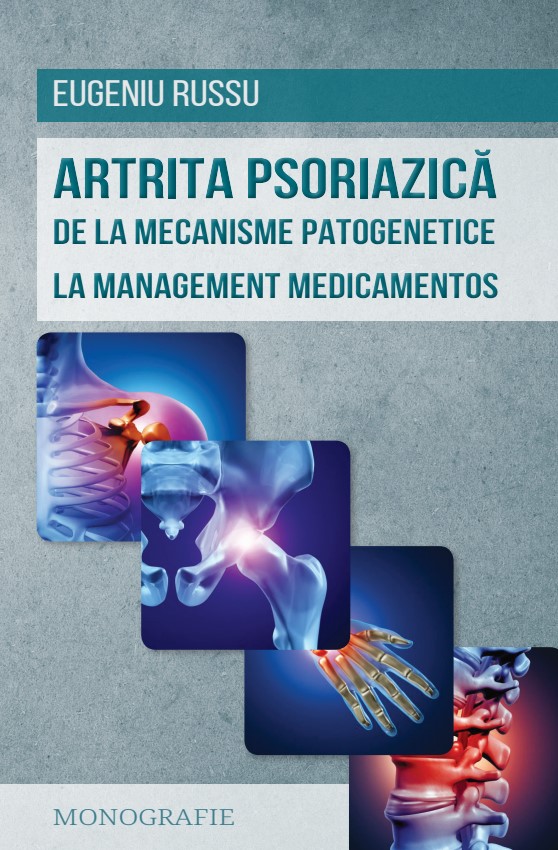
Psoriatic arthritis (PsA) is a complex, chronic inflammatory disease with heterogeneous clinical manifestations and significant functional, social, and economic impact. In this context, the monograph “Psoriatic arthritis – from pathogenetic mechanisms to pharmacological management” authored by Eugeniu Russu, MD, PhD, associate professor, represents a timely and valuable contribution to the medical literature, particularly within the Romanian-language academic space.
The monograph provides a comprehensive and well-structured overview of psoriatic arthritis, integrating current international scientific evidence with original clinical and immunological research conducted on patient cohorts from the Republic of Moldova. The author succeeds in combining fundamental concepts of immunopathogenesis with clinical realities, offering a coherent and up-to-date synthesis of PsA as a systemic inflammatory disease rather than a purely articular condition.
A major strength of this work lies in its original research component. The author presents detailed analyses of immunological disturbances observed in patients with PsA, highlighting significant alterations in cellular and humoral immunity, particularly in patients with severe clinical phenotypes. These findings contribute novel regional data and enrich existing international knowledge regarding disease heterogeneity and immune dysregulation in psoriatic arthritis.
Equally important is the exploration of genetic susceptibility factors. The monograph discusses the association of various HLA alleles with PsA in the studied population and emphasizes correlations between specific genetic profiles and distinct clinical forms of the disease. These observations underline the multifactorial nature of PsA and support the concept of personalized risk stratification and prognosis assessment.
The interdisciplinary approach adopted throughout the monograph is particularly noteworthy. Concepts from clinical rheumatology, immunology, genetics, and molecular biology are integrated into a unified pathogenetic model, facilitating a deeper understanding of disease mechanisms. This approach reflects contemporary trends in translational medicine and supports the development of individualized therapeutic strategies.
From a practical perspective, the monograph has substantial clinical applicability. The author presents current diagnostic algorithms, emphasizes the importance of early detection in patients with cutaneous psoriasis, and reviews modern imaging techniques used for diagnosis and monitoring. The therapeutic chapters are aligned with the most recent international guidelines (ACR/NPF and EULAR), covering conventional synthetic DMARDs, biological therapies, and targeted synthetic agents, as well as treatment optimization and tapering strategies.
The work also addresses prognosis, comorbidities, and patient education, reinforcing the importance of a patient-centered, multidisciplinary management approach. The clear and accessible academic style makes the monograph suitable not only for specialists but also for residents, doctoral students, and clinicians involved in the care of patients with psoriatic disease.
In conclusion, “Psoriatic arthritis – from pathogenetic mechanisms to pharmacological management” is a scientifically rigorous, original, and clinically relevant monograph. It fills an important gap in Romanian-language medical literature and represents a valuable reference for rheumatologists, dermatologists, and other healthcare professionals. The author demonstrates academic maturity, critical thinking, and a strong capacity to integrate research findings into clinical practice. This monograph fully meets the standards of a modern scientific work and deserves wide dissemination within the medical and academic community.
Ninel Revenco, MD, PhD, Dr. Hab., university professor
Head of Department of Pediatrics
Nicolae Testemițanu State University of Medicine and Pharmacy, Republic of Moldova