Expression of estrogen and progesterone receptors and their clinicopathological correlations in serous ovarian carcinoma
https://doi.org/10.52645/MJHS.2025.4.01
Introduction
Ovarian cancer continues to be the most lethal gynecologic malignancy, with high-grade serous ovarian carcinoma representing the most common and aggressive histological subtype. Although estrogen receptor and progesterone receptor have established prognostic and therapeutic relevance in other hormone-dependent cancers, such as breast carcinoma, their role in high-grade serous ovarian carcinoma remains insufficiently characterized and requires further elucidation.
Materials and methods
A retrospective study was conducted on 40 cases of high-grade serous ovarian carcinoma diagnosed between 2022 and 2024 at two medical institutions in Chișinău, Republic of Moldova. Estrogen receptor and progesterone receptor expression was evaluated by immunohistochemistry, employing the Allred scoring system (range: 0–8). Clinical and pathological data were collected, including patient age, menopausal status, tumor grade, FIGO stage, CA-125 serum levels, and tumor laterality. Statistical analysis comprised descriptive statistics, Student’s t-test, Kruskal-Wallis test, Spearman’s rank correlation, Mann-Whitney U test, and Chi-square test. A p-value < 0.05 was considered statistically significant.
Results
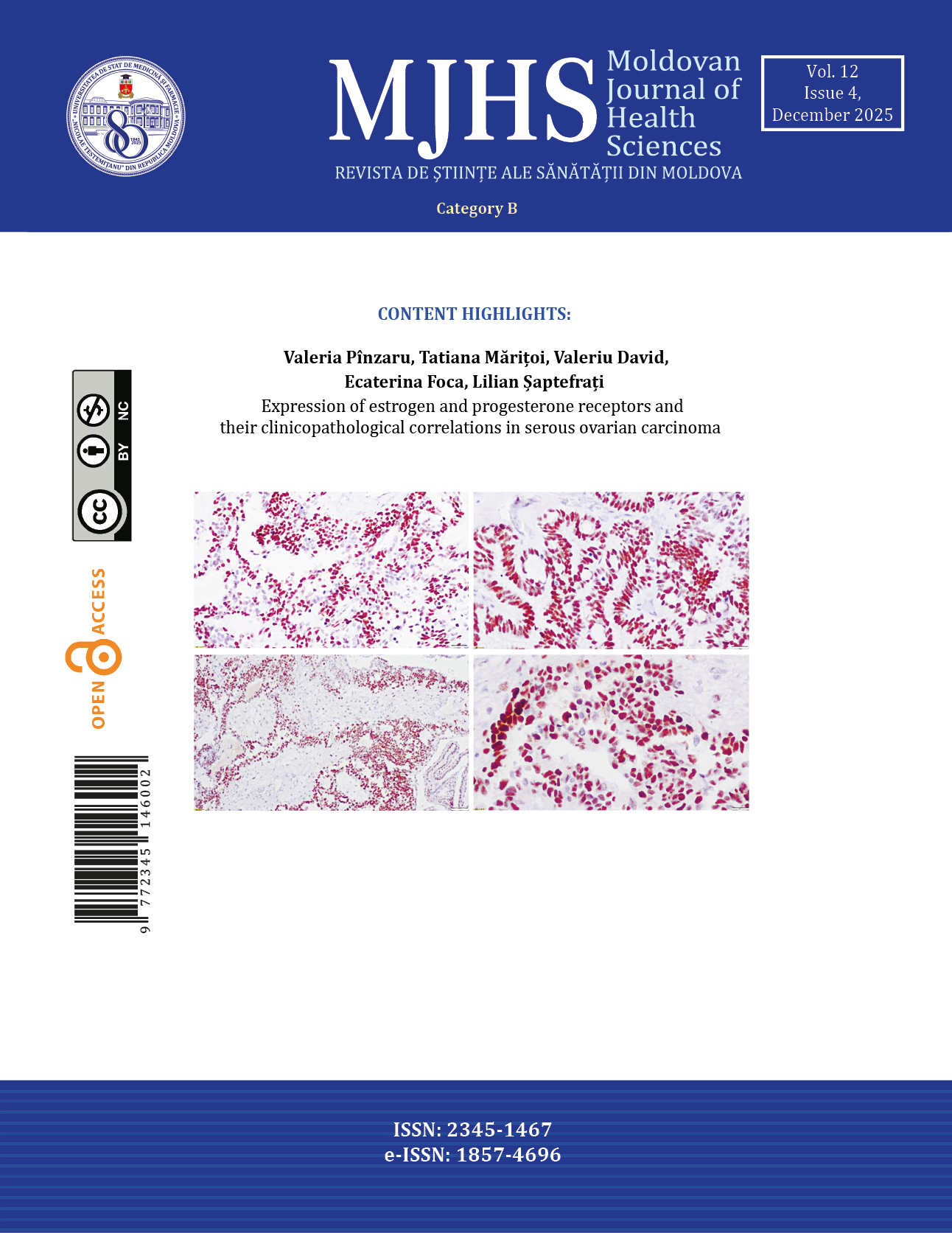
Estrogen receptor positivity was detected in 60% of cases (Allred scores 4-8), exhibiting a diffuse nuclear staining pattern, whereas progesterone receptor positivity was observed in 50% of cases (scores 2–6) with focal or mosaic staining. Four immunoprofiles were identified: ER+/PR+ (35%), ER+/PR− (25%), ER−/PR+ (15%), and ER−/PR− (25%). A significant positive correlation was found between ER and PR expression (ρ = 0.472, p = 0.001). Elevated CA-125 levels were significantly associated with advanced FIGO stage (H = 15.52, p = 0.0014), higher tumor grade (H = 4.15, p = 0.041), and PR negativity. Bilateral ovarian involvement showed a strong correlation with advanced disease (ρ = 0.658, p < 0.00001). The ER−/PR+ immunoprofile was predominantly associated with the most advanced FIGO stages. No significant differences in estrogen receptor or progesterone receptor expression were observed between premenopausal and postmenopausal patients.
Conclusions
Hormone receptor expression in high-grade serous ovarian carcinoma exhibits significant associations with key clinicopathological parameters, including CA-125 levels, tumor grade, FIGO stage, and tumor laterality. Notably, loss of progesterone receptor expression correlates with more aggressive tumor behavior. Hormonal receptor profiling using the Allred scoring system may provide valuable insights for prognostic stratification and aid in therapeutic decision-making in serous ovarian carcinoma. Further investigations involving larger patient cohorts and comprehensive molecular characterization are warranted to validate and expand upon these findings.